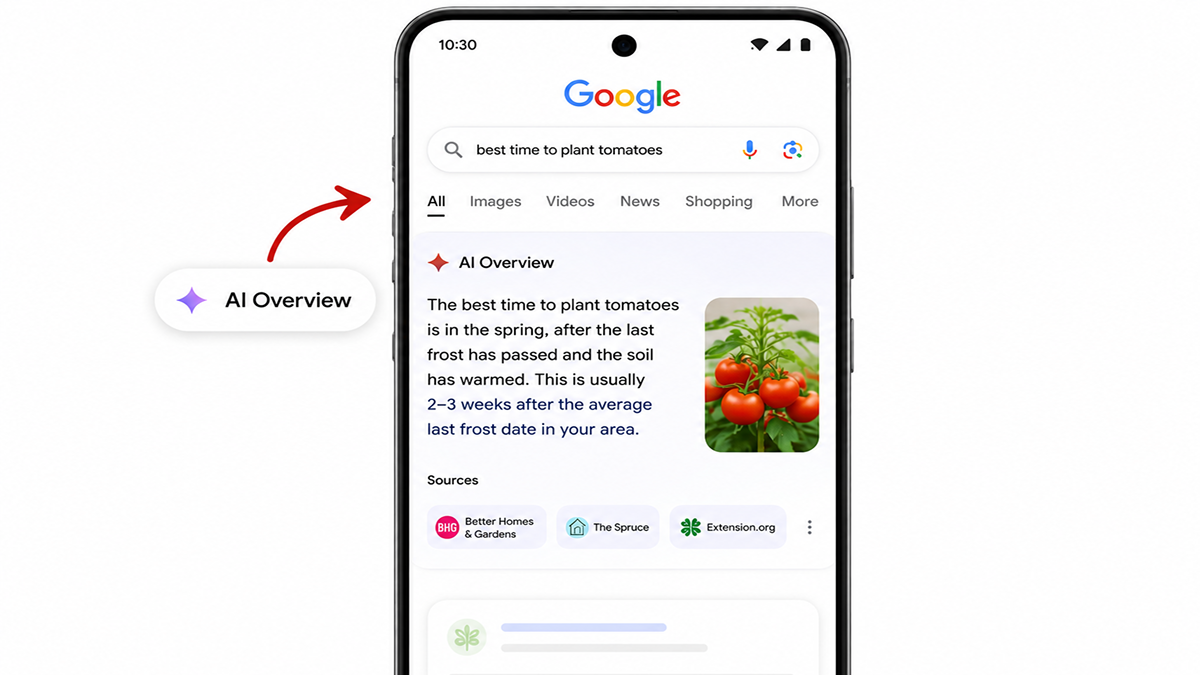
Google AI Overviews now appear at the top of search results for millions of queries. They pull answers from pages Google trusts and show them before any organic result. If your content is not being cited, a competitor's content is. Here is how to change that.
Google AI Overview is an AI-generated answer box that appears at the top of search results. It summarizes information from multiple sources and links back to the pages it pulls from. For users, it gives a fast answer. For brands, it is a major visibility signal.
Getting cited in an AI Overview does not always mean more clicks. But it does mean more trust. Users see your brand as a source Google relies on. That matters for long-term authority and brand recognition, even when the click goes elsewhere.
AI Overviews show up most often for informational and commercial queries. If your business creates educational content around what you do, these are the queries you need to rank for.
Google does not pull content at random. It looks for pages that already rank well organically, then pulls specific passages that answer a query directly. That means two things need to be true for your content to appear: it needs to rank, and it needs to be written in a format that AI can extract quickly.
Pages with vague, rambling intros rarely get cited. Pages with a clear direct answer in the first two sentences get pulled far more often. Google is looking for the most useful passage for a given query, not the most interesting article.
The good news is that most of what helps you rank in traditional search also helps you get into AI Overviews. Strong topical authority, clear structure, and content that matches search intent are the foundation.
Topical authority is one of the strongest signals for AI Overview inclusion. If your site covers a subject in depth across multiple pages, Google sees it as a reliable source on that topic. A single well-written post is not enough.

To build topical authority signals, map out every question your audience asks about your core service. Then create content that answers each one. Over time, this depth tells Google that your site knows the subject thoroughly.
For example, if you offer SEO services, you should have content covering how SEO works, what technical SEO involves, how long rankings take to improve, what schema markup does, and dozens of related questions. Each page adds to the overall authority picture.
Content topic clusters are the best way to build this structure. A main pillar page covers the broad topic. Supporting cluster pages go deep on each subtopic. Internal linking ties them together so Google can follow the relationships clearly.
The most common reason content gets skipped by AI Overviews is poor structure. If your answer is buried three paragraphs in, behind context and background, AI will find a page that leads with the answer instead.
Write your answers first. Put the direct response in the first sentence of every section. Then expand with context and detail. This works for both readers and AI systems pulling passages.
Use question-style H2 and H3 headings where it makes sense. Headings like "What is topical authority?" and "How does FAQ schema markup help rankings?" match how users search. AI Overviews pull from sections that clearly align with a query.
Bullet points and numbered lists are also extracted often. If you are explaining a process or listing options, use a structured list rather than burying it in a paragraph. Google can pull a clean list directly into an AI Overview without editing.
Structured data markup is code added to your pages that tells Google exactly what your content contains. FAQ schema is one of the most useful formats for AI Overview optimization because it maps directly to how AI Overviews pull question-and-answer content.
Adding FAQ schema to your service pages and blog posts makes it easier for Google to identify which sections are relevant to a query. It also increases your eligibility for rich results in traditional search, which builds the rankings you need to get considered for AI Overviews in the first place.
If you want to optimize for AI Overview visibility at scale, a structured data audit is a practical starting point. ReachGiant builds schema markup into every SEO project as standard, not as an optional add-on. Learn more about our SEO services at reachgiant.com/seo/
Internal linking does two jobs. It helps Google understand the relationships between your pages, and it passes authority from stronger pages to newer ones. Both matter for AI Overview eligibility.
A strong internal linking strategy means your topical cluster pages all link back to the pillar page, and the pillar page links out to each cluster. This creates a clear map Google can follow. It also keeps users on your site longer, which is a positive engagement signal.
When you publish a new page, always link to it from at least two or three existing pages. Do not leave new content sitting in isolation. Without internal links pointing to it, Google is slower to find and rank it, which delays any chance of AI Overview inclusion.
AI Overviews appear most often for long-tail queries, the specific, multi-word questions users type when they want a clear answer. These are lower competition, higher intent, and more likely to trigger an AI-generated response.
Phrases like "how to improve topical authority for a new website" or "what is the difference between featured snippets and AI Overviews" are the kind of queries where AI Overviews show up regularly. If your content answers these questions in a direct, structured format, you have a real chance of being cited.
Use your FAQ sections to target these queries specifically. Write each question the way a user would actually ask it. Then answer it in two to three clear sentences. This format is ideal for both AI Overview inclusion and featured snippet eligibility.

Featured snippets and Google AI Overviews often pull from the same content. Pages that earn featured snippets for a query are strong candidates for AI Overview inclusion too. The content qualities that earn both are almost identical: direct answers, structured formatting, and strong topical relevance.
If you are trying to get cited in AI, targeting featured snippets is a practical way to confirm your content is structured correctly. Check which queries your site is close to ranking for a featured snippet. Then tighten the answer, improve the structure, and add any missing schema.
This dual-optimization approach is one of the most efficient ways to build AI search visibility while also strengthening traditional organic performance.
Getting into Google AI Overviews is not about gaming a new system. It is about doing content right. Build topical authority through depth, structure your content so the answer comes first, use FAQ schema markup, and connect your pages through strong internal linking.
The brands getting cited consistently are the ones that have invested in quality, structure, and relevance across their whole site. If you want a team to help you build that foundation, ReachGiant is ready to help.
Book a free strategy session and we can walk through where your site stands today.
1. What is a Google AI Overview?
A Google AI Overview is an AI-generated answer box at the top of search results. It pulls content from pages Google trusts and summarizes them for the user. Being cited signals that Google considers your content a reliable source on the topic.
2. How do I get my content into Google AI Overviews?
Start by ranking organically for the query. Then structure your content with direct answers at the top of each section, use FAQ schema markup, and build topical authority through a cluster of related pages. Google pulls from pages that rank and answer clearly.
3. Does ranking on page one guarantee AI Overview inclusion?
No, but it is a prerequisite. Google typically pulls AI Overview content from pages in the top ten results. Ranking well is the first step. After that, content structure and passage clarity determine whether you get cited.
4. What type of content is most likely to appear in AI Overviews?
Informational content that answers a specific question directly. FAQ sections, how-to guides, numbered lists, and comparison content are all pulled frequently. Content with vague or unfocused writing rarely gets cited.
5. Does FAQ schema markup help with AI Overviews?
Yes. FAQ schema helps Google identify which parts of your page are question-and-answer pairs. This makes it easier for AI to pull a specific passage for a matching query. It also improves your chances of earning rich results in standard search.
6. What is topical authority and how does it affect AI Overview inclusion?
Topical authority means your site covers a subject deeply across multiple related pages. Google favors sources with clear expertise. A site with thorough, focused content on a topic is more likely to be cited in AI Overviews than a site with one broad page.
7. How does internal linking help with AI visibility?
Internal linking helps Google understand how your pages relate to each other. A well-linked content cluster signals expertise on a topic. It also passes authority across pages, which helps newer content rank faster and become eligible for AI citation sooner.
8. Can small business websites appear in AI Overviews?
Yes. AI Overviews reward clarity and relevance, not just domain authority. A small business with well-structured content, strong topical focus, and proper schema markup can get cited ahead of larger brands with weaker content.
9. How often do AI Overviews appear in search results?
They appear most often for informational queries and some commercial queries. They do not appear for every search. The frequency varies by query type, device, location, and Google's ongoing testing. Monitor your target queries regularly in incognito mode to track when they appear.
10. How long does it take to get cited in a Google AI Overview?
There is no fixed timeline. Pages that already rank in the top ten can start appearing in AI Overviews relatively quickly after content improvements. Pages that need to build rankings first may take three to six months before they become candidates for citation.




.png)

.png)
.png)

.png)
.png)
.png)






.svg)