Only 0.63% of users ever click on page two search results. That means your competitors sitting on page one are capturing nearly all of the traffic, leads, and customers for the keywords that matter to your business. An SEO competitor analysis shows you exactly why they rank where they do, and what it will take to get above them.
This guide walks you through the full process, step by step, using both free methods and paid tools.
An SEO competitor analysis is the process of studying the websites that outrank you in Google Search. You look at their keywords, content, backlinks, and technical SEO to find patterns, gaps, and opportunities you can use to build a stronger strategy.
It is important to understand one thing early: your SEO competitors are not always the same as your business competitors. A business competitor sells the same product or service to the same audience. An SEO competitor is any website that ranks for the keywords you want, whether that is a direct rival, an industry blog, a news site, or a comparison platform.
For example, a local law firm competing for "personal injury attorney Los Angeles" might find that their page one SEO competitors include legal directories like Avvo, editorial sites like Nolo, and only one or two actual competing law firms. Knowing this changes how you build your strategy.
Before you analyze anything, you need the right list of competitors to study.
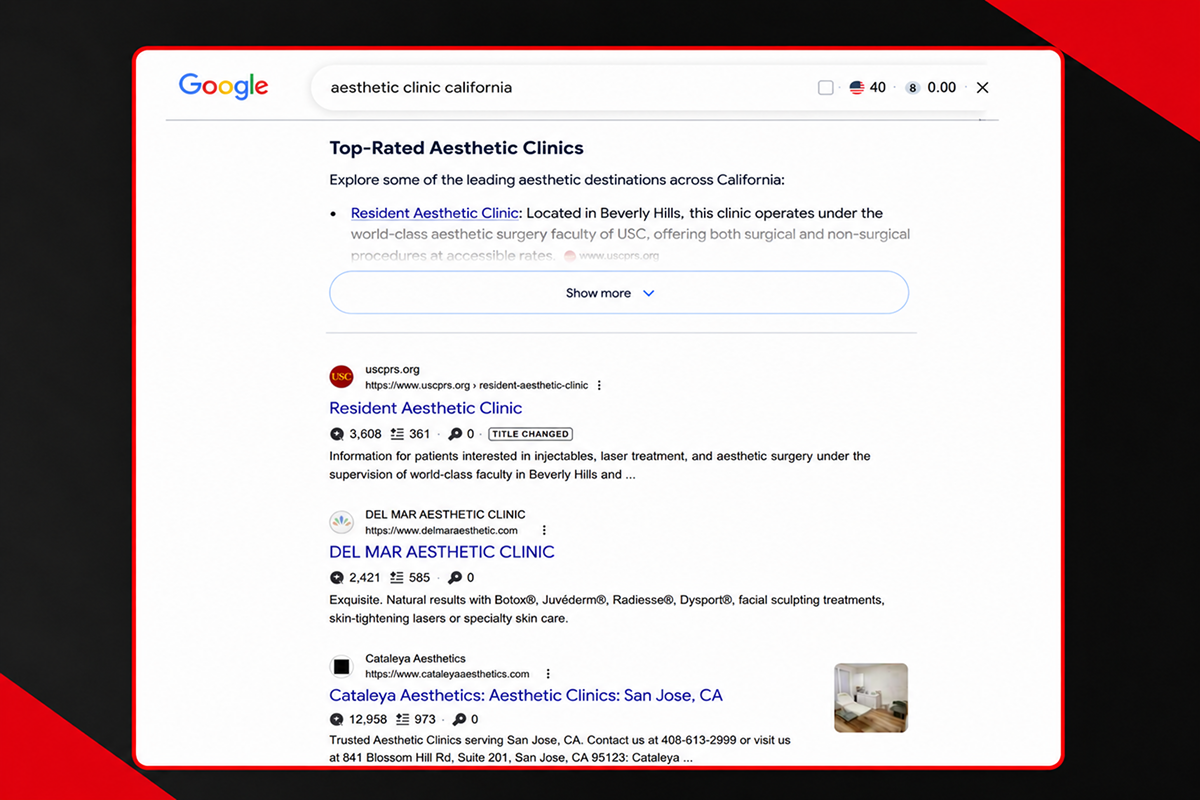
This screenshot shows a Google search for "aesthetic clinic california" with three paid results appearing at the top of page one. Each of these sites is an SEO competitor for that keyword, and tools like Surfer SEO (visible in the browser bar) can show you their traffic, keyword count, and authority metrics at a glance while you browse the results.
Tools like Ahrefs, Semrush, and Moz have competitor discovery features. Enter your domain, and the tool will show which sites rank for the most overlap with your own keyword set. This is faster and more accurate than manual searching, especially if you target a large number of keywords.
Build a list of five to ten true SEO competitors. This list becomes the foundation for every step that follows.
Once you have your competitor list, the next step is finding out which keywords are sending them the most organic traffic.
Search each competitor's domain in Google using the site: operator. Browse their top pages and take note of the topics they cover most heavily. Check which content appears in featured snippets, People Also Ask boxes, and image results. These are signals of strong keyword performance.
Enter a competitor's URL into Ahrefs Site Explorer or Semrush Organic Research. Filter by top pages and sort by estimated traffic. Export the keyword list and look for terms with clear search intent that match your own service or content offering.

Ahrefs Site Explorer is one of the most widely used tools for competitor keyword research. Enter any competitor's URL, and you get a full breakdown of their organic keywords, top pages by traffic, referring domains, and backlink profile, all in one dashboard. The data updates regularly, so you are always working with current ranking information rather than outdated snapshots.
A keyword gap analysis shows you every keyword your competitors rank for that your site does not. These missing keywords represent pure opportunity. Competitors attract traffic for these queries, but you do not even compete for them yet.
Here is how keyword gaps are typically categorized:
To run a keyword gap analysis, use Semrush's Keyword Gap tool or Ahrefs' Content Gap feature.
If you want to understand keyword research at a deeper level before running a gap analysis, that foundation will help you prioritize the results more effectively.
Knowing which keywords competitors rank for is only part of the picture. You also need to understand how they build and structure the content that earns those rankings.
The goal is not to copy what competitors publish. It is to identify what Google is already rewarding for that query and then build a page that covers the topic more completely, more clearly, and more accurately.
96.55% of all web pages get zero organic traffic from Google. One of the biggest reasons is a weak backlink profile. Backlinks from other websites tell Google that your content is credible and worth ranking. Your competitors who outrank you almost always have more referring domains pointing to their key pages.
A backlink gap analysis identifies sites that link to your competitors but not to you. Tools like Ahrefs' Link Intersect let you plug in your domain and three or four main competitors. The tool then produces a list of all websites that have linked to at least one competitor but have never linked to you.
Those websites already link to content like yours. That makes them far more likely to link to you than a cold prospect with no connection to your topic. Start your outreach there.
Strong content and backlinks can only do so much if a site has technical problems holding it back. Checking competitor technical SEO helps you spot weaknesses you can exploit and standards you need to meet to compete.
If a competitor ranks well despite poor technical scores, that tells you their content and backlinks are strong enough to compensate. If your technical SEO is cleaner, that is a structural advantage you already have. Use it.
Our SEO services at ReachGiant include a full technical SEO audit as part of every competitor analysis we run, so you know exactly where your site stands relative to the competition before we build your strategy.
One of the most overlooked parts of an SEO competitor analysis is checking how well competitors match search intent across their content. Search intent is the reason behind a search query. Getting it wrong means writing content Google will not rank, regardless of how well optimized it is.
There are four intent types to check for across competitor content:
Look at which intent types your competitors cover well and which ones they ignore. If all the top-ranking sites for a keyword focus heavily on informational content but none of them have a strong commercial page, that is a gap you can fill with a focused service or product page that matches buying intent.
All of the research above is only useful if it leads to a clear action plan. Here is how to turn competitor data into priorities you can act on:
Regular competitive analysis, combined with trigger-based reviews, ensures your SEO strategy remains responsive to market dynamics. Run a full competitor analysis every quarter, and do a quick review any time a major algorithm update hits, or a new competitor starts outranking you on key terms.
If you want help turning this process into a strategy that drives real ranking growth, ReachGiant works with businesses across the US to do exactly that. Get in touch or book a free meeting to get started.
AI tools have made competitor analysis faster, especially for content research and keyword pattern spotting. Here is where they help most and where they fall short.
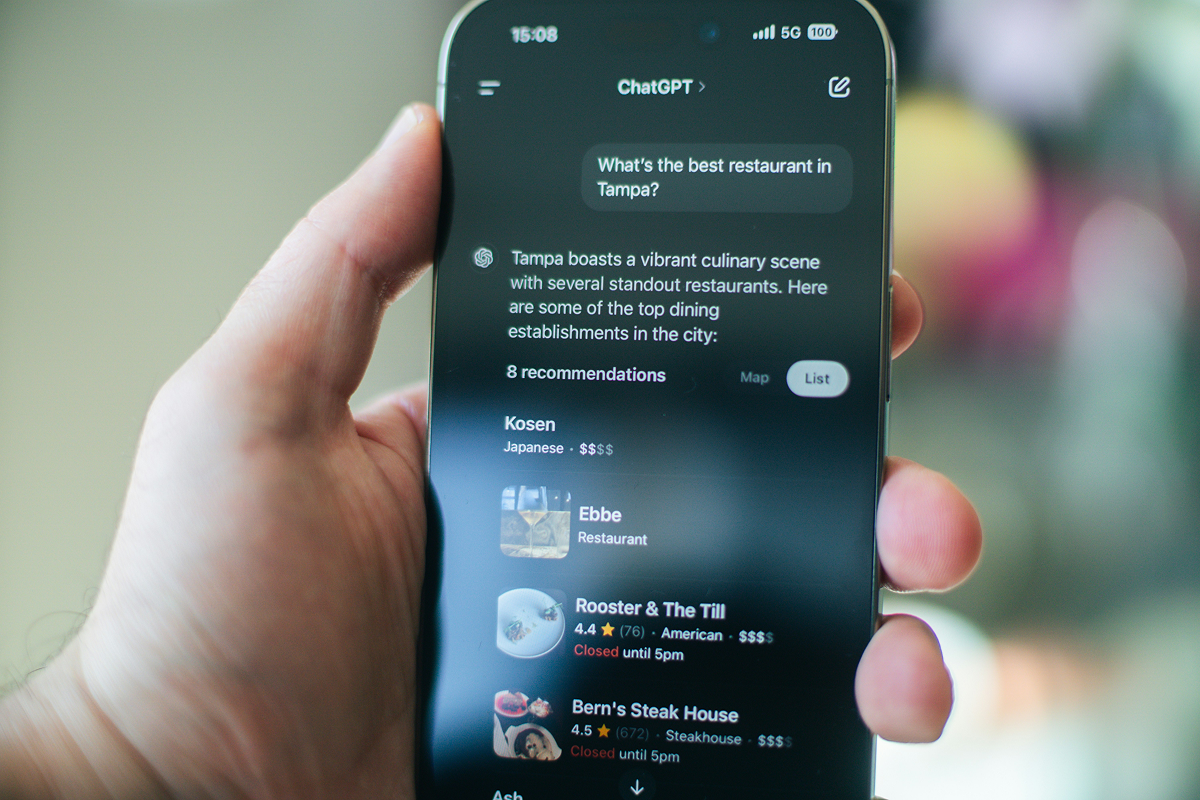
You can use the ChatGPT cheat sheet for ready-to-use prompts built specifically for SEO competitor research tasks.
AI tools do not have access to live ranking data, backlink counts, or real search volume numbers. Everything an AI tool tells you about a competitor's performance needs to be validated against a real SEO tool like Ahrefs, Semrush, or Google Search Console before you act on it. Use AI to generate ideas and save research time. Use data tools to confirm which ideas are worth pursuing.
An SEO competitor analysis is not a one-time task. It is an ongoing part of any serious SEO strategy. The sites that consistently outrank you are not guessing. They are building content around proven keyword demand, earning backlinks from relevant sources, and maintaining strong technical foundations.
The process in this guide gives you a clear framework to do the same. Identify your real SEO competitors, find their keyword and content gaps, analyze their backlink profile, check their technical SEO, and build a prioritized action plan from what you find.
If you want a full competitor analysis done for your site, along with a clear plan for outranking them, ReachGiant builds SEO strategies around exactly this kind of research. Our SEO services cover keyword research, content strategy, technical SEO, and link building under one roof. Get in touch or book a free meeting to get started.
How do you perform a competitor analysis in SEO?
Identify which sites rank for your target keywords, analyze their top ranking keywords and content, run a keyword gap analysis, review their backlink profiles, check their technical SEO, and build an action plan based on what you find. Repeat this process quarterly.
What are the 5 steps of a competitive analysis?
Identify your SEO competitors, analyze their keyword rankings, run a keyword gap analysis, review their backlink profile, and audit their technical SEO. Each step builds on the last, and together they give you a complete picture of why competitors outrank you.
Can ChatGPT do a competitor analysis?
ChatGPT can help summarize competitor content, generate keyword ideas, and spot content gaps. It cannot access live ranking data, backlink counts, or real search volume. Use it alongside tools like Ahrefs, Semrush, or Google Search Console for accurate data.
How do you do competitor analysis without expensive tools?
Use Google Search to find competitors for your target keywords. Use the site: operator to browse their top pages. Check Google Search Console for your own keyword gaps. Use free tiers of Ubersuggest or Moz for basic keyword data. Google PageSpeed Insights and the Mobile-Friendly Test are both free for technical checks.
Which AI is best for competitor analysis?
ChatGPT works well for content summarizing and keyword brainstorming. Perplexity is useful for real-time research on competitor positioning. Neither replaces a dedicated SEO tool for ranking and backlink data. The best approach combines an AI tool with Ahrefs or Semrush.
Is there a tool to analyze competitor SEO strategy?
Yes. Ahrefs, Semrush, and Moz are the most widely used. Ahrefs is strongest for backlink data and content gap analysis. Semrush has the best keyword gap tool. Moz is a good budget option for smaller teams. SpyFu is a lower-cost alternative worth considering for keyword and ad data.
How do you conduct a competitor analysis in SEO, and why is it valuable?
You study competitor keywords, content, backlinks, and technical SEO to find what is working in your space and where gaps exist. It is valuable because it removes guesswork from your strategy. Instead of building content based on assumptions, you build it based on what Google is already rewarding in your niche.
Which SEO techniques boost website ranking and visibility?
The most effective techniques include targeting keywords with clear search intent, building quality backlinks from relevant sites, publishing comprehensive content that covers a topic in depth, fixing technical issues like slow load times and crawl errors, and using internal links to connect related pages across your site.
How can improving SEO boost visibility on Google Search?
Better SEO means Google can find, index, and understand your pages more easily. When your content matches what searchers are looking for, your technical performance is strong, and other sites link to you as a credible source, Google ranks your pages higher. Higher rankings mean more impressions, more clicks, and more organic traffic.
How do I find keyword gaps between my site and competitors?
Use Semrush's Keyword Gap tool or Ahrefs' Content Gap feature. Enter your domain alongside two or three competitors. The tool shows every keyword they rank for that you do not. Sort by search volume and keyword difficulty to prioritize which gaps to fill first.
How often should I run an SEO competitor analysis?
Run a full analysis every quarter. Do a quick check anytime a major Google algorithm update rolls out or when you notice a new site outranking you on important keywords. Competitive landscapes shift, and your strategy needs to stay current with those changes.


.png)

.png)
.png)

.png)
.png)
.png)





.svg)