
Your customers now ask ChatGPT and Google AI Mode the questions they used to type into a search box. Keyword rankings alone no longer show whether those tools recommend you. AI search rank tracking tools try to close that gap, and at ReachGiant we help businesses read that data and act on it.
AI search rank tracking tools check whether AI platforms mention your brand when people ask relevant questions. They run a set of prompts on a schedule and record what comes back.
Most of them report four things. Whether your brand was named, whether your pages were cited as a source, how you compare against competitors, and how that changes over time.
The last one is often called share of voice. It answers a simple question about how much of the conversation in your category belongs to you. If a buyer asks an AI tool for the best option in your market ten times, share of voice is how often you get named. Our explainer on AI-based keyword ranking tools covers how this differs from the rank trackers you already use.
A classic rank tracker asks one question. Where does this page sit for this keyword? That was the whole game when search meant ten links.
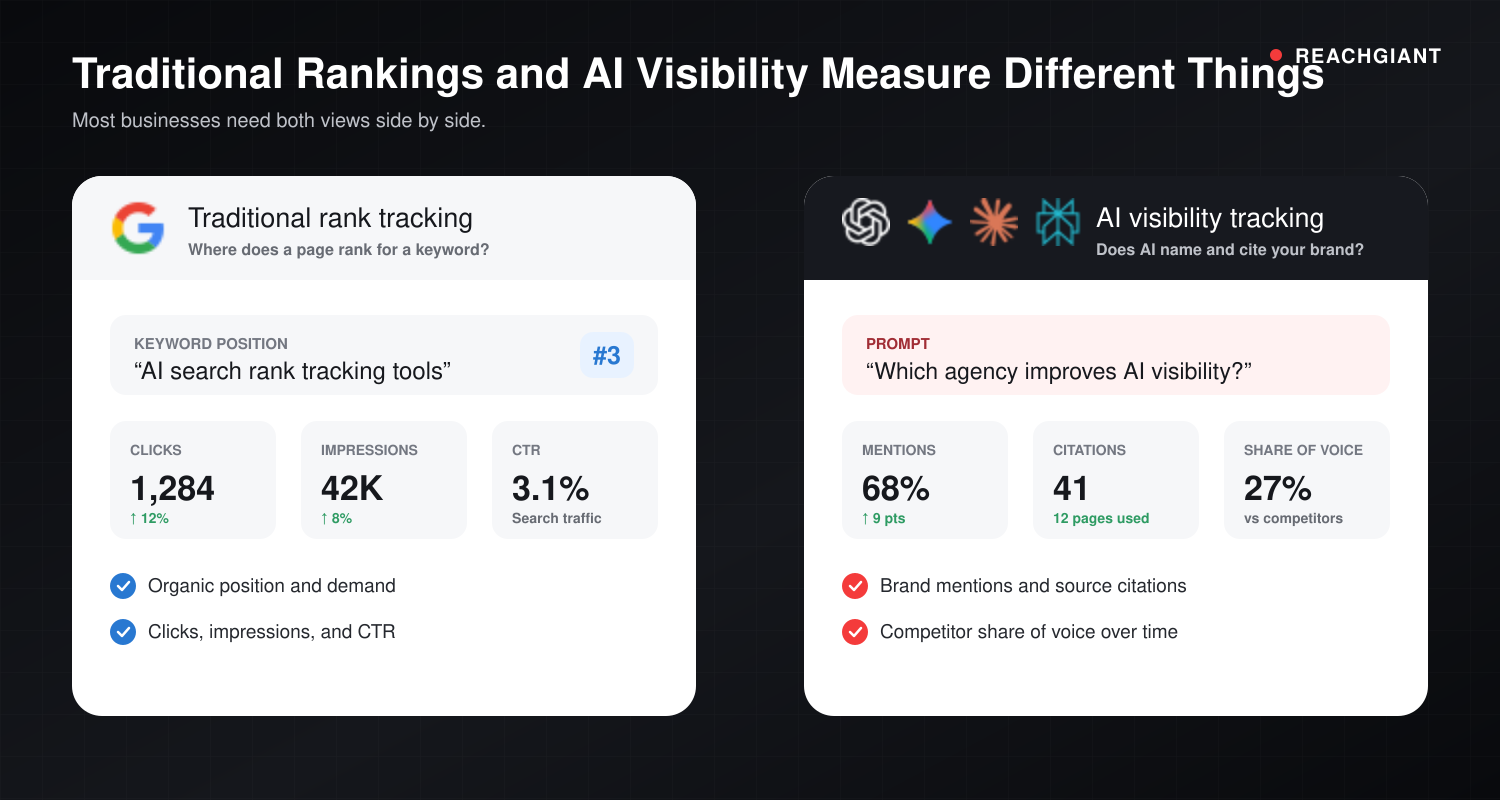
AI answers work differently. Google describes a query fan-out method where one question becomes many searches, then the results get combined into a single response. Your page might get cited for a sub-question you never targeted. Or your competitor gets named while you rank first and go unmentioned.
Neither tool replaces the other. Keyword rankings still show demand and organic position. AI tracking shows whether machines trust you enough to repeat your name. Most businesses need both numbers side by side.
Judge platforms on capability, not on tool-count lists. Competitor monitoring is the feature most teams underuse. Knowing which rival gets named repeatedly tells you what to fix. Our guide to running an SEO competitor analysis applies here with very little change.
These are the criteria that matter most.
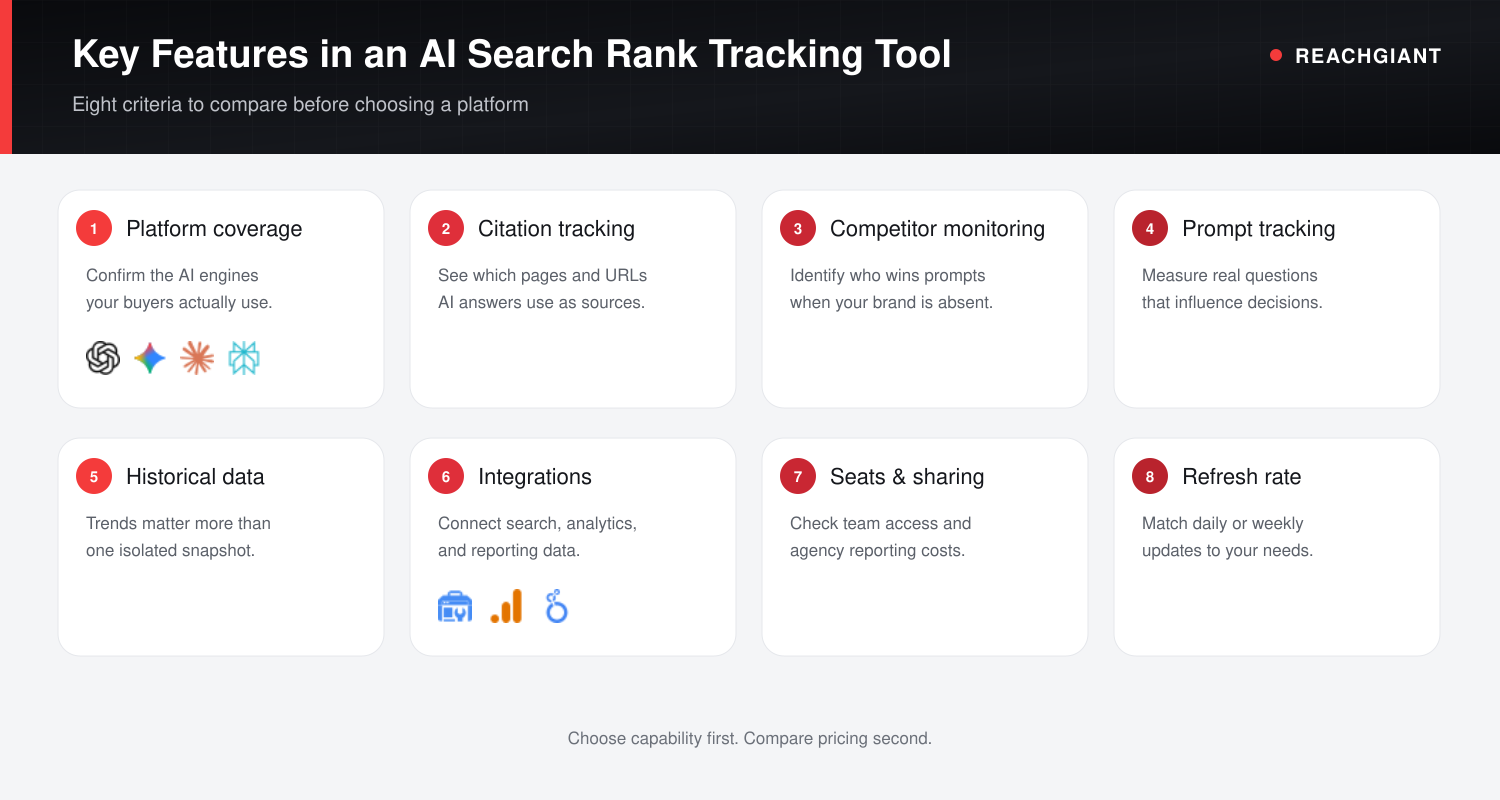
Rather than rank these, here is how they tend to sort by use case.
Already paying for an SEO suite. Semrush and Ahrefs both offer AI visibility modules. Coverage is shallower than the specialists, but it is bundled and needs no new contract. Start here before buying anything.
Mid-market brands and agencies. Peec AI and Rankability are strong middle options. Peec AI leans toward analytics and share of voice reporting. Rankability pairs tracking with content workflows, which suits teams that want the fix and not just the number.
Enterprise. Profound and Scrunch AI target larger organizations. Both offer security certifications, broad platform coverage, and reporting built for many stakeholders. Both cost accordingly.
Small budgets. Rankscale, Otterly, and LLMrefs give you core monitoring at entry-level prices. You lose depth and polish. For a first look at whether you appear at all, that is usually enough.
Most teams end up with two subscriptions rather than one. A traditional SEO suite for rankings and crawling, plus a specialist tool for AI answers.
Pricing and features in this category change fast, so treat any list as a starting point and run a trial before committing.

Be honest about the limits of AI search rank tracking tools before you spend money on one.
AI answers vary between users, sessions, and locations. Two people asking the same question can get different brands named. That means every score is a sample, not a fact. Treat a single week of data as noise.
No platform sees inside these systems either. They observe outputs the same way you would, just at scale and on a schedule.
Also check what you already own. Google Search Console now includes a generative AI performance report showing how often your pages appear in AI Overviews and AI Mode. It reports impressions by page, country, and device. It does not include clicks, CTR, or the queries behind them, and access is still rolling out. It is free, though, and worth checking before you buy a paid tool.

AI search rank tracking tools earn nothing on their own. The data only pays off when it changes what you publish and what you fix.
Read your prompt reports for gaps. If AI answers a competitor's name for a question you should own, you need a properly optimized page that answers it better and more directly. If your citations cluster on two pages, the rest of your site is not readable enough to get used.
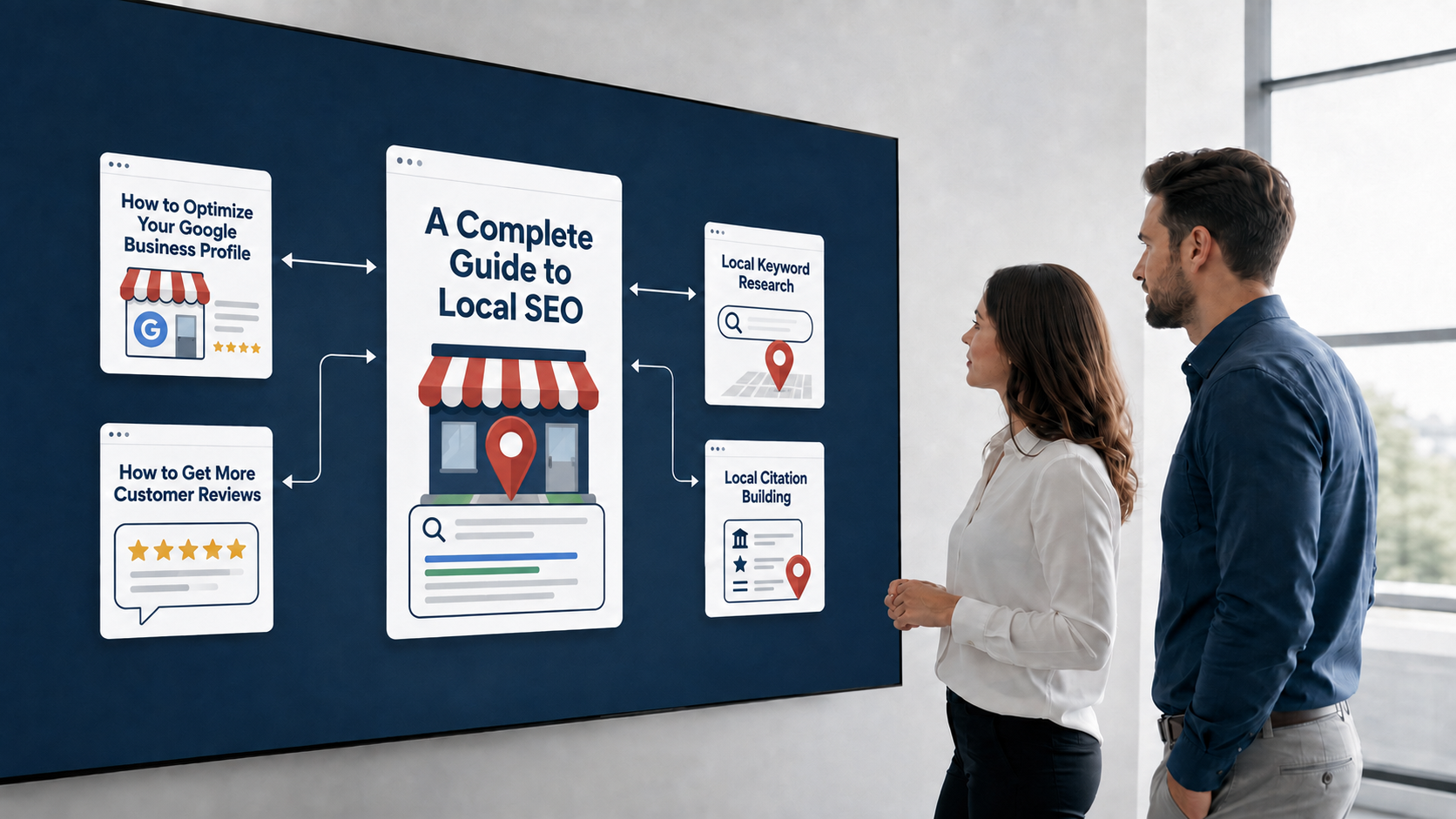
Feed the winning topics into clusters rather than single posts. Fan-out rewards depth across linked pages. Our post on structuring content for AI search covers the formatting side of that work.
Then check the technical basics, because content blocked from crawlers cannot be cited at all. Our AI SEO services handle the tracking, the content, and the technical work as one program, since fixing one without the others rarely moves the number.
Check Search Console first, since it is free. Then pick one paid tool that covers the platforms your buyers actually use, and give it a full quarter before you judge the trend. AI search rank tracking tools will tell you where you stand. They will not write the page that gets you cited, and that page is what actually moves the number.
If you want help turning visibility data into a plan, book a meeting with our team or get in touch for a visibility review.
What are AI search rank tracking tools?
They are platforms that run prompts across AI search tools on a schedule and record whether your brand gets mentioned or cited. They report brand mentions, citations, competitor comparisons, and changes over time.
How do AI rank trackers differ from traditional SEO tools?
Traditional trackers measure where a page sits for a keyword. AI trackers measure whether an AI answer names you at all. One tracks position, the other tracks inclusion in a generated response.
Can I track rankings in ChatGPT and Google AI Mode?
Not rankings in the classic sense, since there is no numbered list. You can track how often you are mentioned or cited, which prompts trigger it, and how you compare with competitors.
Which AI search platforms should businesses monitor?
Start with ChatGPT, Google AI Overviews, and Google AI Mode, since these carry the most volume. Add Perplexity, Gemini, and Claude if your audience or category leans technical.
What metrics matter most in AI search visibility?
Share of voice against named competitors, citation counts by page, and the trend line across weeks. Single-day scores are unreliable because AI answers change between sessions and users.
Are AI rank tracking tools accurate?
They are directionally useful, not precise. Answers vary by user, session, and location, so every tool reports a sample. Judge trends over months rather than trusting any single reading.
Do small businesses need AI search monitoring tools?
Not always. Check the free Search Console report first, then run manual prompt checks. Buy a tool once AI search visibly affects your leads and you need consistent reporting.
How can AI visibility improve SEO performance?
Prompt gaps show which questions competitors own, which guides your content plan. Citation patterns reveal which pages are readable to machines and which need clearer structure.
Can Google Search Console track AI search visibility?
Partly. Its generative AI performance report shows impressions from AI Overviews and AI Mode by page, country, and device. Clicks, CTR, and query data are not included, and access is still expanding.
Should businesses combine AI rank tracking with traditional SEO reporting?
Yes. Rankings show demand and organic position. AI tracking shows whether machines repeat your name. Reviewed together, they explain why impressions can climb while clicks stay flat.


.png)

.png)
.png)

.png)
.png)
.png)






.svg)