
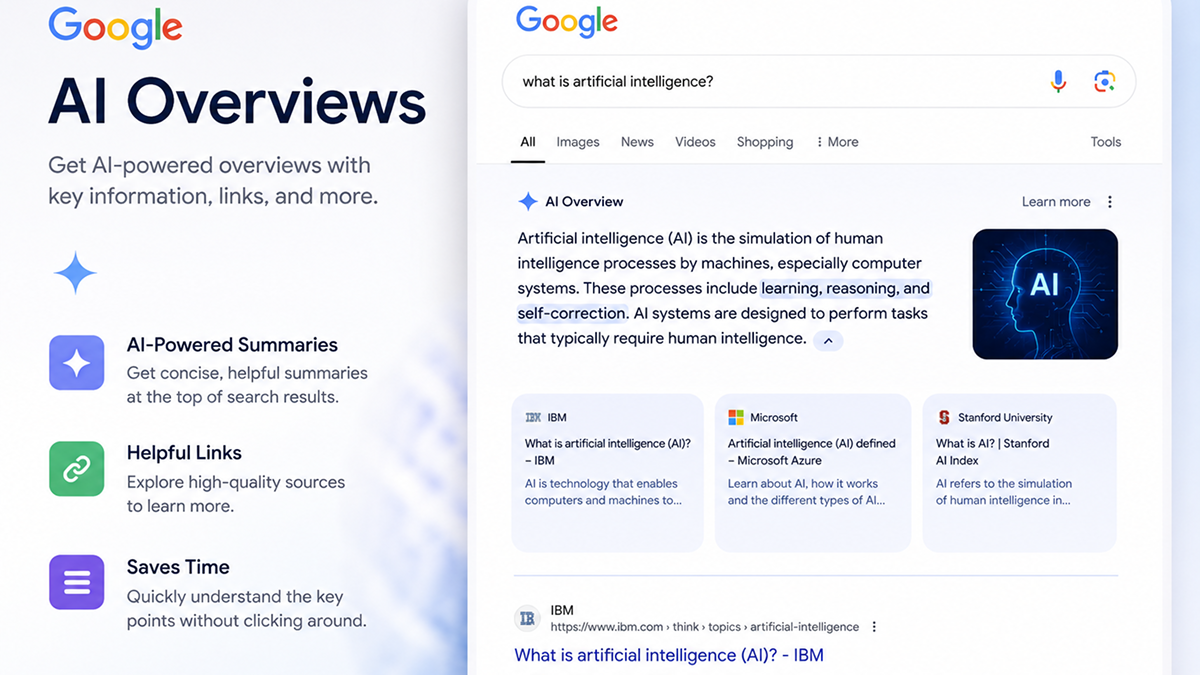
Google AI Overviews pull answers directly from web pages and display them at the top of search results. If your content is not structured the right way, it gets skipped. Here is what it takes to optimize content for Google AI Overviews and improve your chances of being cited.
Google AI Overviews are AI-generated answer boxes that appear at the top of certain search results. They pull information from multiple sources and summarize an answer for the user, with links to the pages cited.
These overviews appear most often for informational queries, especially questions and long-tail phrases. If your page gets cited in an AI Overview, it can drive traffic even when users do not click the traditional search result below it.
Understanding how this format works is the first step in any content strategy built around generative AI search.
Many people treat AI Overviews like an updated version of featured snippets. They are related but not the same.
A featured snippet pulls a specific passage from one page. An AI Overview synthesizes information from multiple pages to generate a complete answer. Google selects sources based on relevance, authority, and how clearly the content answers the query being asked.
This means your page does not need to be the single best result to be cited. It needs to be clearly authoritative, well-structured, and directly relevant to the specific question.
There are several practical steps that improve your chances of appearing in AI-generated answers.
AI Overviews reward content that answers questions clearly and quickly. For every topic you cover, lead with a direct answer in the first paragraph. Do not bury the answer three sections into a long article.
Use the question as a heading where it makes sense. Then give a one or two sentence answer right below it. This format matches how AI systems extract and present information from web pages.
AI Overviews appear most often for conversational, long-tail search queries. These are the specific, multi-word questions real people type when they want a detailed answer.
Instead of targeting broad terms only, build content around the full questions your audience asks. "How do I structure content for AI search?" performs better in this format than just "AI content strategy" as a standalone keyword target.
The way your content is organized matters as much as what it says. AI systems look for clearly labeled sections, short paragraphs, and logical flow throughout the page.
Use H2 and H3 headings to break content into named sections. Keep paragraphs to two or three sentences. Use bullet lists for steps and comparisons. Avoid large blocks of text with no clear structure or visual breaks between ideas.
Schema markup tells Google what type of content is on your page and how different pieces of information relate to each other. Adding structured data for FAQs, articles, and how-to content helps AI systems categorize and cite your content accurately.
FAQ schema is especially useful. Pages with FAQ schema are more likely to have their question-and-answer pairs pulled directly into AI-generated responses at the top of the page.
E-E-A-T stands for Experience, Expertise, Authoritativeness, and Trustworthiness. Google uses these signals to evaluate whether a source is worth citing in an AI Overview.
Here is how to demonstrate real E-E-A-T on every page you publish. Include detailed author bios with real credentials on every article. Cite credible sources when making factual claims. Link to original research, government data, or recognized industry publications. Keep all information accurate and current. Make sure your About page and contact details are easy to find from any page on the site.
Thin content with no author information and no external citations is less likely to be cited in AI Overviews, even if it ranks in traditional search results.
FAQ sections are one of the most effective formats for AI Overviews. AI systems look for clear question-and-answer pairs that match the structure of conversational search queries.
Each FAQ answer should be concise and self-contained. The reader should not need surrounding context to understand the answer. Keep each response to two or three sentences and address the question directly without building up to it across multiple paragraphs.
Pages that reference authoritative external sources signal that the content is grounded in real information. AI systems are more likely to cite sources that themselves reference credible data.
Link out to recognized publications, academic research, or official government and industry sources where relevant. This is not just about trust signals. It shows your content is part of a broader, reliable information ecosystem that Google can point users toward.

Google's shift toward AI-generated answers changes what good SEO looks like in practice.
Traditional SEO focused on ranking a single page for a single keyword. AI Overviews pull from multiple sources and synthesize information across them. This means topical coverage and content depth matter more than ever before.
A site with strong topical authority across a subject is more likely to be cited across multiple AI Overviews than a site with one well-optimized page. Building a content library around related questions is now a core part of any effective search strategy.
According to Search Engine Land, pages cited in AI Overviews tend to be those with clear structure, strong E-E-A-T signals, and direct, well-sourced answers to specific questions.
At ReachGiant, our SEO services are built to help businesses stay visible as Google's search format continues to change. We combine technical optimization with content strategy to improve performance in both traditional and AI-generated search results.
Optimizing content for Google AI Overviews is not a separate strategy from solid SEO. It is the result of doing core SEO work well. Clear structure, strong E-E-A-T, accurate content, schema markup, and direct answers to real questions are the foundation.
The businesses getting cited in AI Overviews are the ones treating every page as a credible, well-organized answer to a specific question their audience is asking.
If you want help building a content and SEO strategy that performs in AI-generated search, contact the ReachGiant team to talk through your goals. You can also book a free consultation and see what a complete plan looks like for your business.
What is one way to optimize content for Google's AI Overviews?
Write direct answers to specific questions at the top of each section. AI systems look for clear, concise responses they can extract and cite. Lead with the answer, keep it to two or three sentences, and use a question as the heading where it fits naturally.
Is an AI Overview sometimes inaccurate?
Yes. AI Overviews can include inaccurate information because they synthesize content from multiple sources and may misrepresent details. Google continues to improve accuracy, but users should verify important claims. Publishing well-sourced, accurate content also improves your chances of being cited correctly in AI-generated answers.
How should I optimize my content for AI search?
Focus on clear structure, direct answers, and strong E-E-A-T signals. Use descriptive headings, short paragraphs, and FAQ sections with concise answers. Add schema markup, cite credible sources, and include detailed author bios. These signals help AI systems identify your content as reliable and worth citing.
How do you optimize content for Google's SGE?
SGE and AI Overviews use similar signals. Write content that directly answers conversational, long-tail queries. Use clear headings and structured layouts. Add FAQ schema. Demonstrate E-E-A-T through author credentials and citations. Build topical authority across related subjects rather than targeting isolated keywords alone.
How can content creators improve their websites for Google SGE?
Start with site structure and content organization. Use descriptive H2 and H3 headings. Add FAQ schema to relevant pages. Publish author bios with real credentials. Cite authoritative external sources. Build out content on related topics to strengthen topical authority across your subject area consistently.
How can you optimize your content to appear in Google's AI Overview results?
Use direct question-and-answer formatting. Add FAQ schema markup. Write clear, well-sourced answers to specific questions. Demonstrate E-E-A-T through author credentials and credible citations. Build topical depth across related subjects. Pages with strong authority and clear structure are cited more often in AI-generated answers.
How do AI Overviews change SEO strategy?
They shift focus from ranking a single page to building topical authority across a subject. AI systems pull from multiple sources, so depth and coverage matter more. A well-organized content library built around related questions is now a core part of competitive SEO strategy.
What is schema markup and why does it matter for AI Overviews?
Schema markup is structured data added to your page's code. It tells Google what type of content is on the page and how pieces of information relate. FAQ schema and article schema help AI systems extract and cite your content accurately in AI-generated search answers.
Does page speed affect your chances of appearing in AI Overviews?
Page speed affects your overall search performance, which can influence AI Overview citations indirectly. Faster pages are more likely to rank well in traditional search, and pages that rank well are more likely to be considered as sources for AI-generated answers. Technical performance still matters.
Do you need to rewrite all your existing content for AI Overviews?
Not necessarily. Start by auditing your top-performing pages. Add direct answers at the top of each section, improve heading structure, add FAQ schema, and check that author bios are current. In many cases, restructuring and adding schema is enough without a full content rewrite.


.png)

.png)
.png)

.png)
.png)
.png)





.svg)