
Your customers now ask ChatGPT and Google AI Mode the questions they used to type into a search box. Sometimes the answer names three companies and yours is not one of them. At ReachGiant, we run this work for clients, and this guide explains how that decision gets made.
AI search optimization is the work of getting your business named and cited when someone asks an AI tool a question in your category.
That is a different goal from ranking. A page can sit at position one and still go unmentioned in the answer above it, while a competitor at position six gets named.
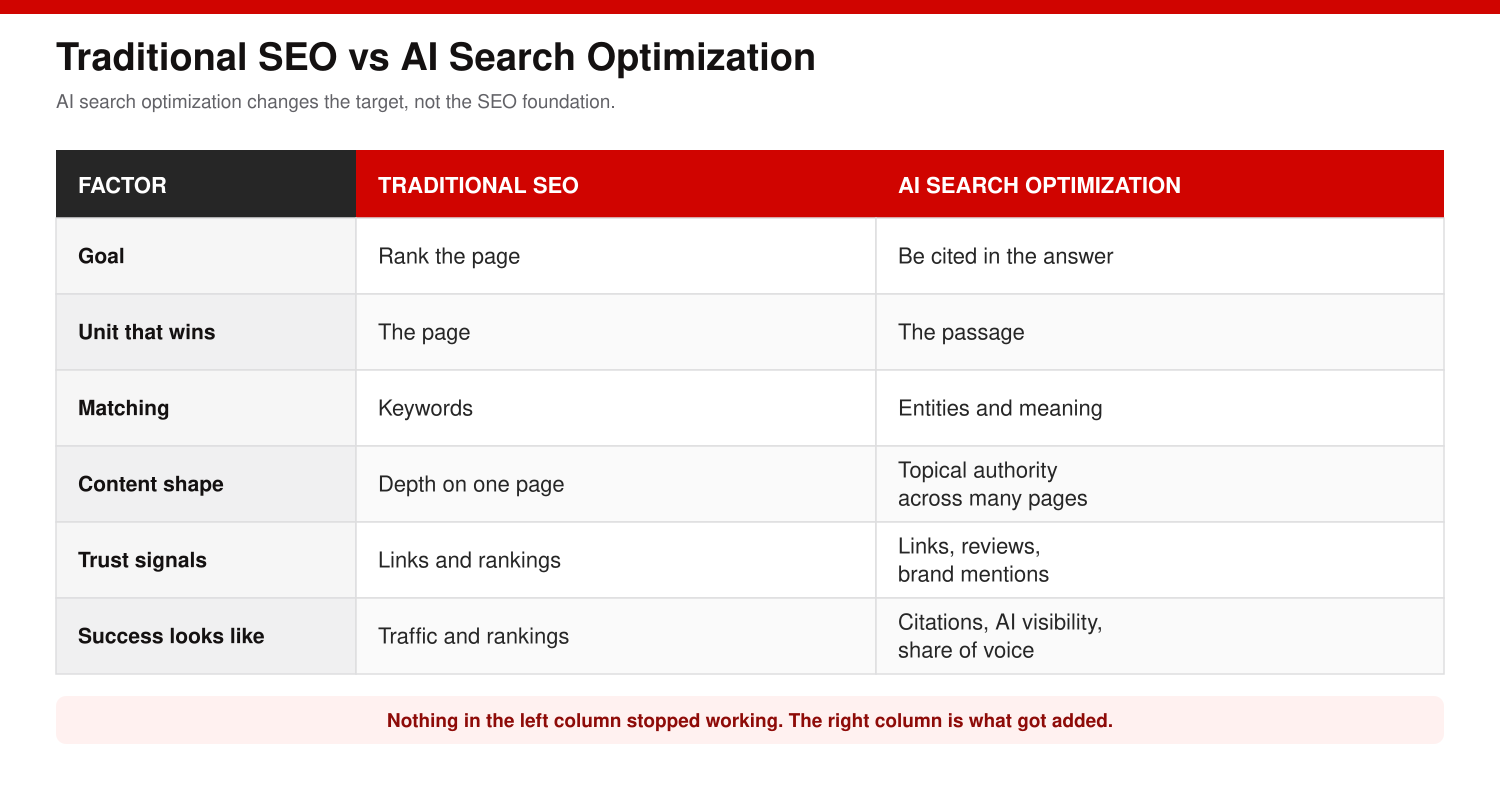
It is not a separate discipline from SEO. Google's documentation on AI features states there is no separate index and no special markup for AI answers. The pages that rank well are the pages that get cited.
What changes is the target. Traditional SEO aims to rank a page so someone clicks it. AI search optimization aims to be the source an answer is built from, whether or not anyone clicks.
Some people call it generative engine optimization, or GEO. The label matters less than the shift behind it.
Skip the machine learning vocabulary. Three things matter for your business.
AI search optimization gets easier once you understand these.
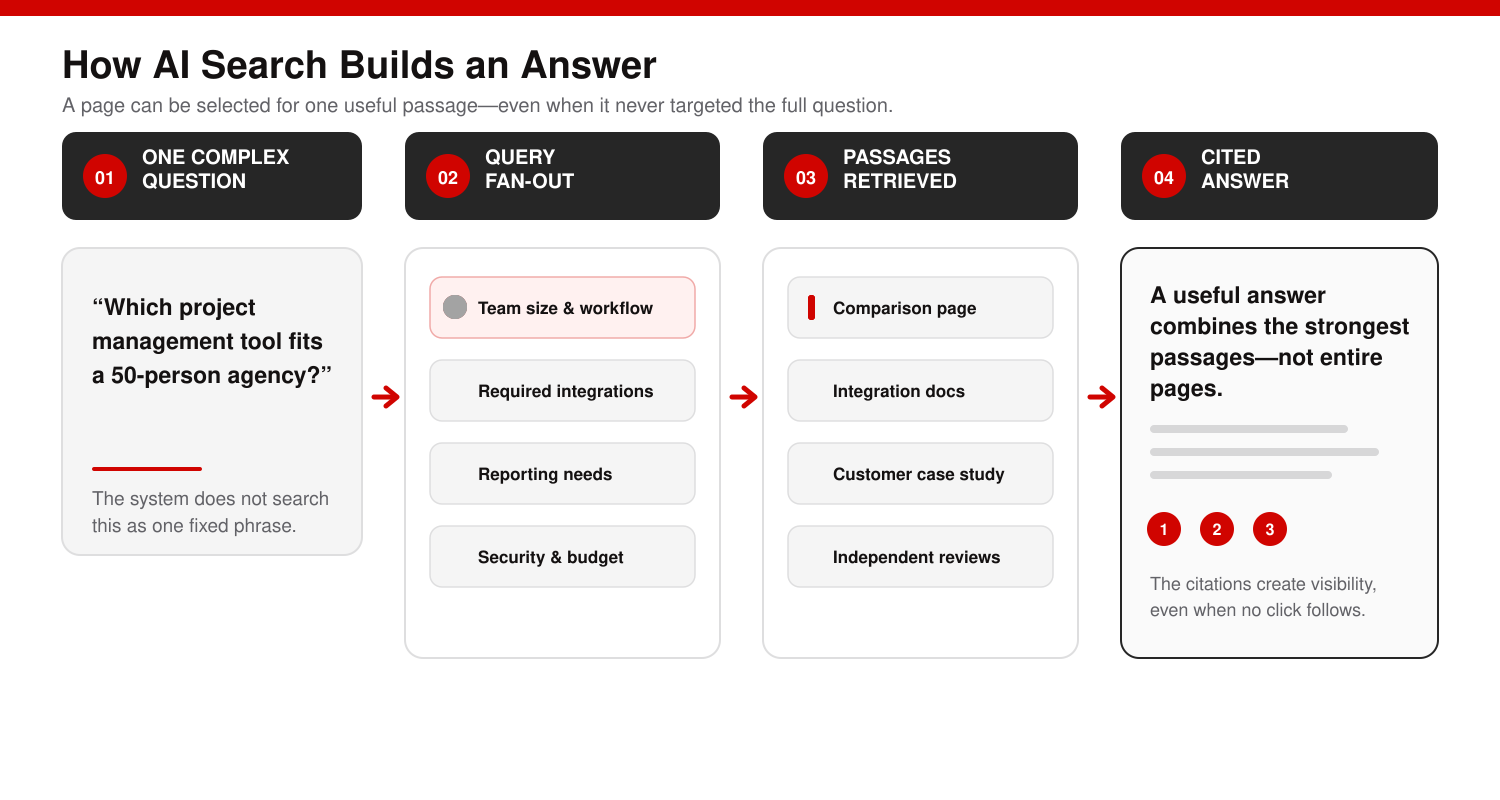
One question becomes many. Google splits a complex question into smaller sub-questions, runs them at once, then combines the results. Your page can get pulled into an answer for a sub-question you never targeted.
Passages get quoted, not pages. Large language models lift sections rather than whole articles. A page answering one clear question per heading gives them more to work with than a page that buries the point.
Meaning beats keywords. These systems match entities and intent, not exact phrases, so cover the related terms a real expert would use. What the rest of the web says about you also carries as much weight as what you say about yourself. Reviews, press coverage, and mentions on respected sites all feed that judgment.
A brand nobody discusses looks risky to recommend. Consumer brands feel this hardest, which our B2C guide covers separately.
Be careful with AI search optimization statistics. The published studies disagree with each other badly, and most articles pick whichever number sounds most dramatic.
Prevalence of AI Overviews is reported anywhere from 18% to 60% of queries depending on who measured. Different samples, countries, and detection methods. None of them is lying. They measured different things.
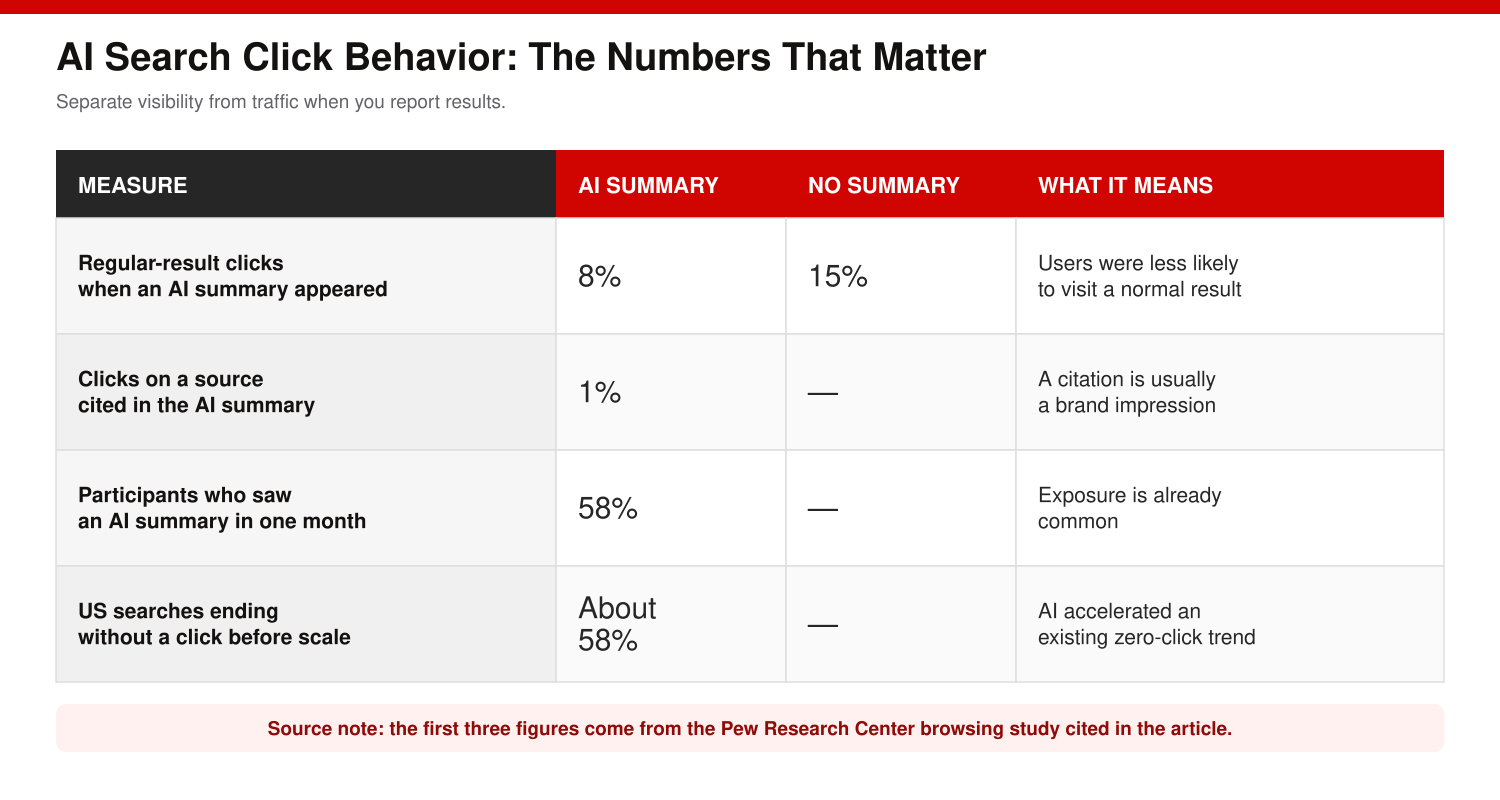
The most reliable click data comes from Pew Research Center, which tracked real browsing rather than survey answers.
That second figure deserves attention. Being cited inside an AI answer is a brand impression, not a traffic strategy. Treating it as traffic will make your reporting look broken.
One more thing worth knowing. A zero-click search is one where someone gets their answer without visiting any website, and that was already the norm before AI summaries scaled. Roughly 58% of US searches ended this way beforehand. AI accelerated a trend it did not create. Our full statistics breakdown covers where the numbers conflict.
AI search optimization is not one target. Different tools behave differently, and your audience decides which matter.
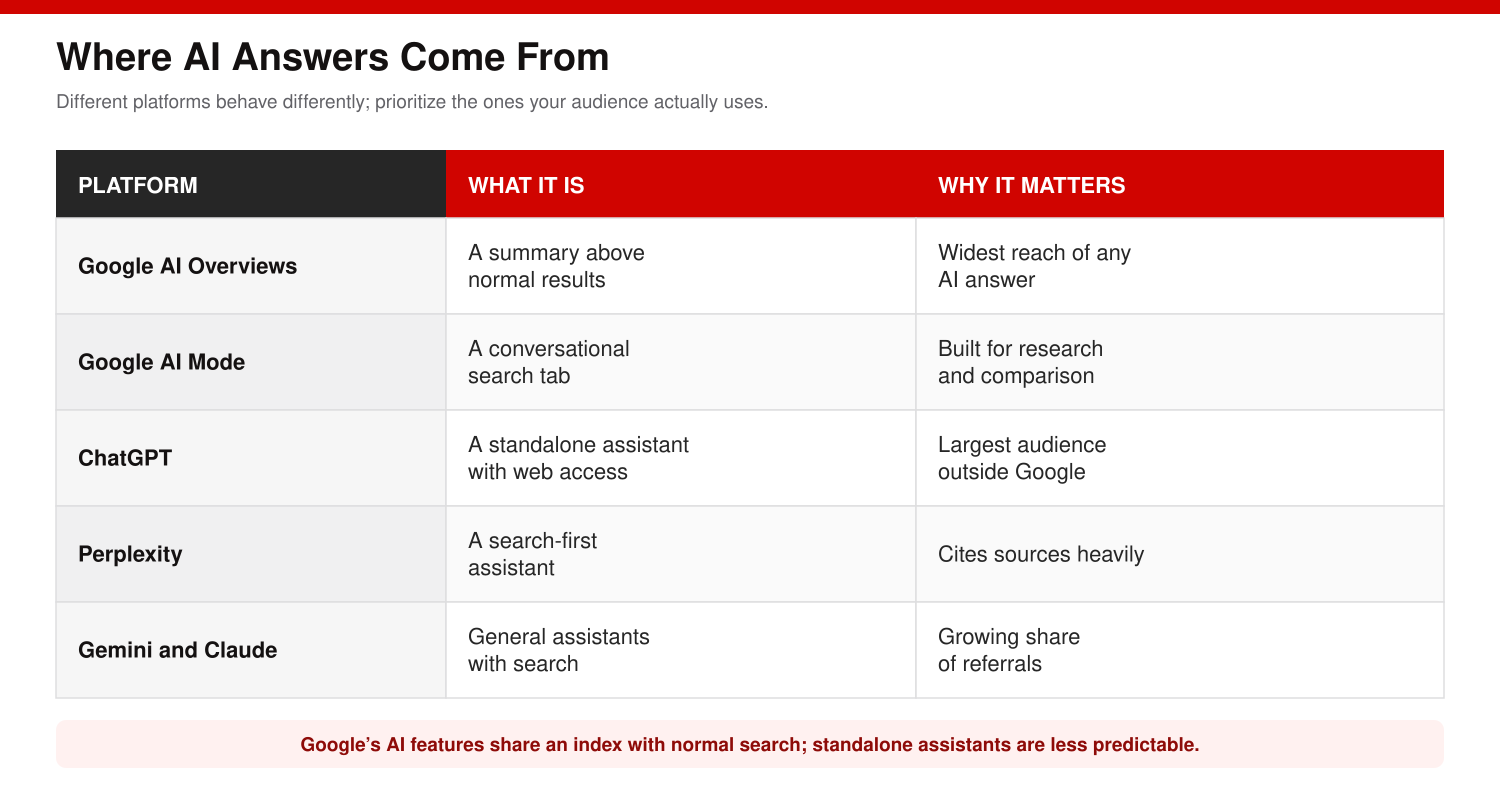
Google's two features share an index with normal search, so strong organic performance carries over. Standalone assistants behave less predictably. Our guide to Google AI Mode breaks down the largest of them in detail.
Five areas, in the order we work through them with clients.
Build topical authority, not single posts. Because one question becomes many, a site covering a subject from ten angles has ten ways to be found. One long article has one. Connect those pages so the relationship is obvious.
Front-load your answers. Put a clear two-sentence answer under every heading, then explain underneath. Add tables, FAQs, and schema markup where it genuinely applies. This does more for citation rates than most technical work, and our ChatGPT optimization guide walks through the page structure in detail.
Publish things nobody else has. Original data, customer stories, and specifics from your own operations. AI tools skip pages that repeat what ten others said, which is also why AI-generated content is only good for SEO when a person adds something to it. Your support tickets and sales calls are full of material competitors cannot copy.
Fix the technical basics. Content that loads after scripts run, or sits behind blocks, cannot be cited at all. Speed, structured data, and clean structure are the gate, not the strategy. Our technical SEO services cover this side.
Earn outside trust. Reviews, brand mentions, named authors with real credentials, and consistent details everywhere you appear. This is the E-E-A-T work Google has always rewarded. It is slow and it compounds.
Whether AI writing tools help or hurt across these five areas depends entirely on quality, which our post on whether AI content ranks covers in practice.
AI search optimization is hard to judge without a baseline, so start free. Google Search Console now reports impressions from AI Overviews and AI Mode by page, country, and device. It has no click or query data yet, and access is still expanding, but it costs nothing.
Beyond that, watch these.
Paid tools cover the rest. They observe outputs on a schedule rather than seeing inside these systems, and answers vary by user and session, so treat any single reading as a sample. Our comparison of AI search rank tracking tools covers what each one can and cannot do, and our post on AI keyword ranking tools covers the keyword side.
AI search optimization works best one topic at a time. Pick your most valuable one, then check whether AI tools name you. If they name a competitor, read their page and work out what it answers that yours does not. Fix that page, then move to the next.
If you would rather have someone run this, book a meeting or get in touch for a visibility review. You can also see how we approach SEO and AI search together.
What is AI search optimization?
AI search optimization is the work of getting your business named or cited when someone asks an AI tool a question in your category. It builds on SEO rather than replacing it, since these systems use the same search index.
Is AI search optimization different from SEO?
The techniques overlap heavily. Google confirms there is no separate index or special markup for AI answers. What differs is emphasis, with more weight on clear passages, topic depth, and outside trust signals.
What is generative engine optimization?
Generative engine optimization, or GEO, is another name for optimizing content to appear in AI-generated answers. The label is newer than the practice, and the underlying work is largely the same as good SEO.
How do I get cited in AI answers?
Answer real customer questions directly, cover topics in depth across connected pages, front-load each section with a clear answer, publish original details, and earn reviews and mentions elsewhere.
Does AI search reduce website traffic?
Often yes for informational pages. Pew measured clicks falling from 15% to 8% when a summary appeared. Transactional and branded searches are affected far less than general questions.
Which AI platforms should my business monitor?
Start with Google AI Overviews, Google AI Mode, and ChatGPT, since those carry the most volume. Add Perplexity, Gemini, and Claude if your audience or category leans technical.
Can I track my visibility in AI search?
Partly. Google Search Console reports impressions from Google's AI features for free. Paid tools observe outputs on a schedule. No tool sees inside these systems, so treat every figure as a sample.
Why do AI search statistics vary so much?
Each study uses different keyword samples, countries, devices, and detection methods. AI answers also change between users and sessions. Trends over months are reliable, single figures are not.
Does AI-generated content hurt my rankings?
Google judges quality, not the tool used to write it. Helpful, accurate, well-checked content can rank. Mass-produced filler is treated as spam whether a person or a machine wrote it.
How long does AI search optimization take?
Formatting changes can affect citations within weeks. Topic depth and outside trust signals take months. Sites with strong organic performance already have a significant head start.


.png)

.png)
.png)

.png)
.png)
.png)






.svg)