
Most AI SEO statistics articles hand you a wall of numbers and leave you to sort out what matters. The numbers are real, but they contradict each other more than anyone admits. At ReachGiant, we track this data because it changes what we build for clients, so here is what holds up and what it means.
AI answers went from a test feature to a normal part of Google Search in about two years. Google AI Overviews now sit above results for a large share of queries. Google AI Mode added a full conversational tab beside them.
Outside Google, ChatGPT, Gemini, Claude, and Perplexity all send real referral traffic to websites. That traffic is small next to organic search, but it is growing quickly and it converts well.
The short version is that search did not disappear. It split into more surfaces, and each one decides differently who gets named. Our guide on ranking in Google AI Overviews covers what earns a citation on the largest of them.
The AI SEO statistics below are each attributed to the group that measured them. Study periods and methods vary, which is exactly why the numbers vary.
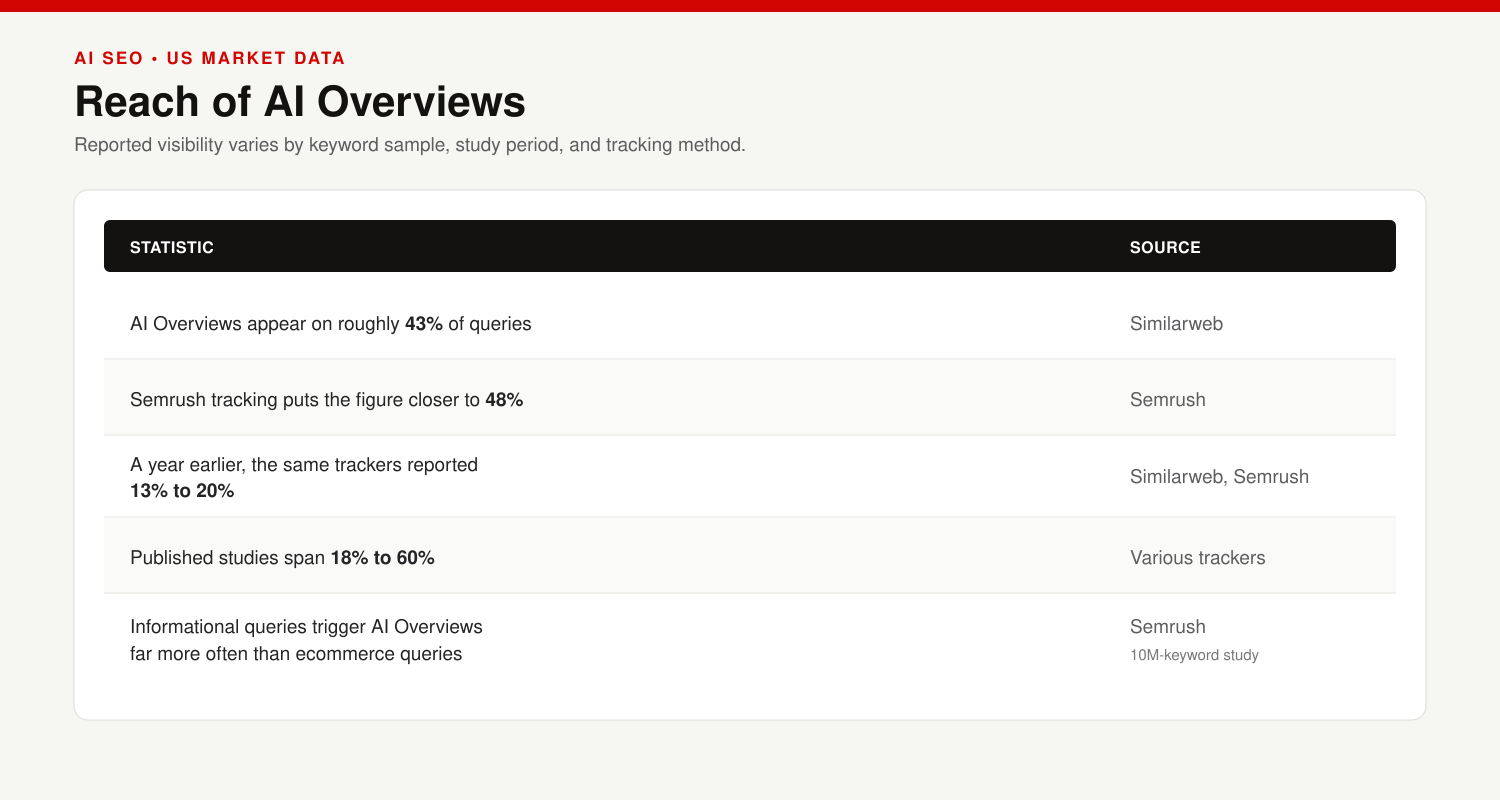
Growth is real and steep. The exact percentage is not knowable, so plan for exposure by query type instead of chasing one headline number. If your money keywords are transactional, your risk is lower than the scary figures suggest.
Pew Research Center ran the strongest study here, tracking real browsing from 900 US adults across 68,879 Google searches.
The click rate roughly halves when a summary appears. More importantly, being cited inside the box is not a traffic strategy on its own, since almost nobody clicks those links. Citation is a brand impression. Treat it that way.
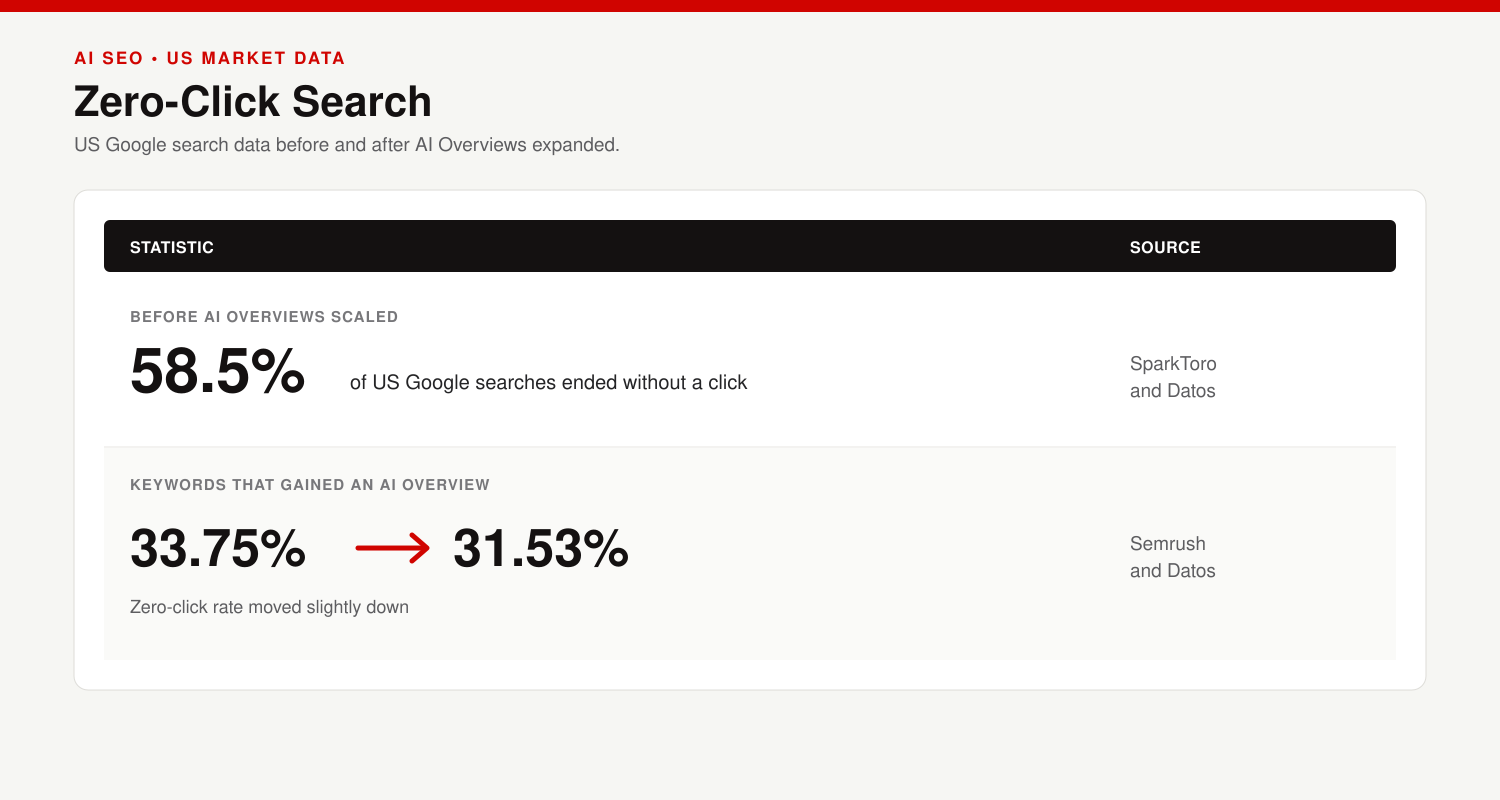
Zero-click search was already the norm years before AI summaries existed. In one large tracking study, adding an AI Overview slightly reduced the zero-click rate rather than raising it. AI accelerated a trend it did not create.
Ranking first is worth less than it was, and the loss is uneven across time and industry. The recovery in the Seer data matters too. This is not a straight line down, so avoid rebuilding your strategy around any single quarter.

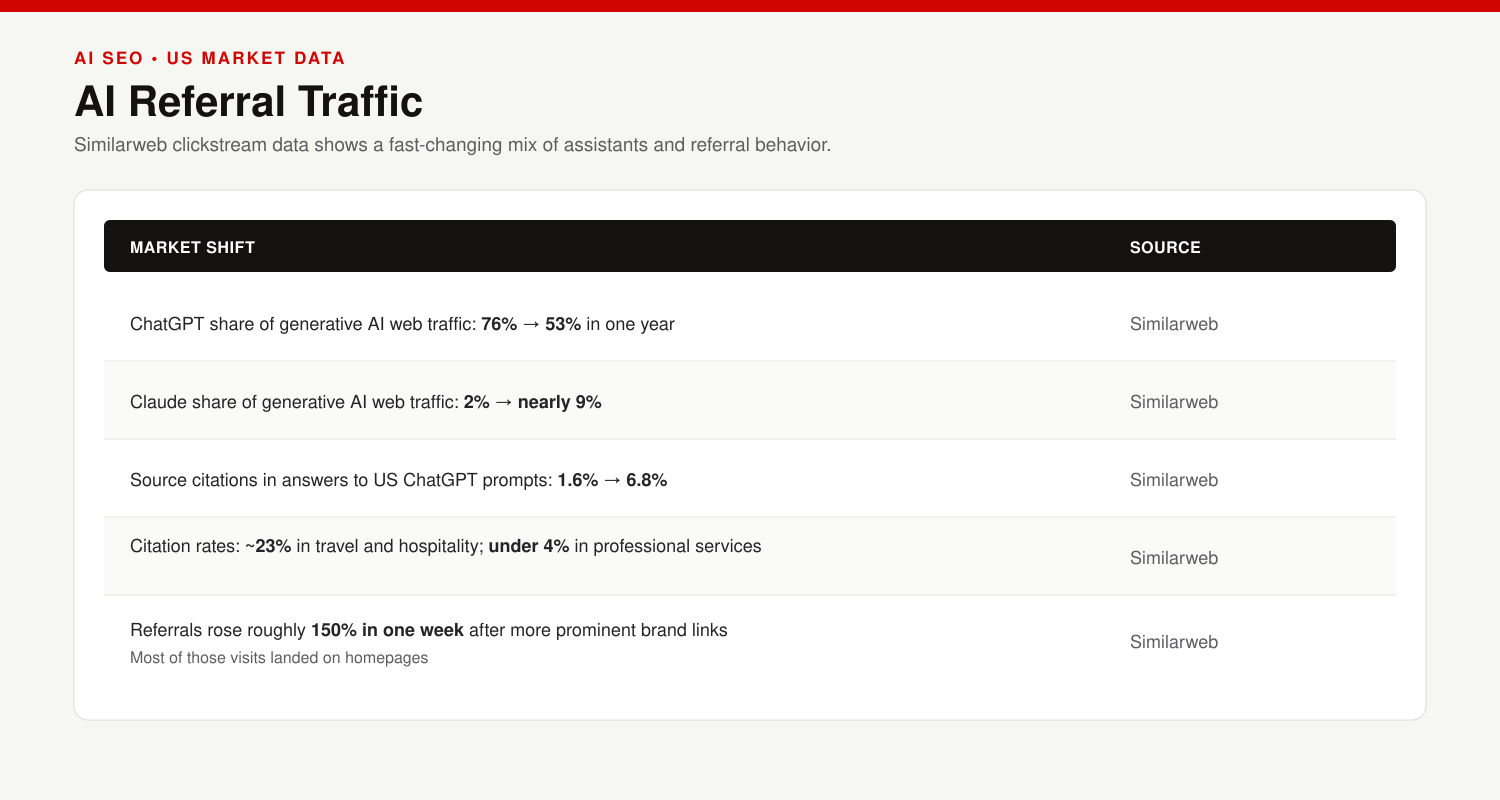
Similarweb clickstream data shows how quickly this side is shifting.
Optimizing for one assistant no longer covers the audience. Also note where those visitors land. If AI tools send people to your homepage, your homepage has to sell, not just look nice.
Treat any single AI SEO statistic with suspicion, including the ones above.
Trackers use different keyword samples, countries, devices, and detection methods. A tool watching 10 million mostly low-volume keywords will report a different figure than one watching 21 million commercial terms. Neither is lying. They measured different things.
AI answers also vary between users and sessions. Two people asking the same question can see different brands named. That makes every measurement a sample.
The practical response is to watch your own data and treat industry statistics as direction, not as targets. Our explainer on AI keyword ranking tools covers what the paid trackers can and cannot see.
Reading the AI SEO statistics together, four shifts matter more than any individual figure.
Impressions matter more than they used to. If clicks fall while your brand still gets named, you are still winning attention. Measuring only sessions will make a healthy program look broken.
Fewer visitors, better visitors. People who click after reading an AI answer have already done their research. Your landing page meets a warmer prospect, so conversion rate deserves as much attention as traffic volume.
Authority beats volume. AI systems repeat sources they trust. Reviews, mentions on respected sites, named authors, and original data all feed that. Publishing more thin posts does nothing. If you are considering AI writing tools, our post on whether AI content ranks is worth reading first.
Technical health became a gate. Content that loads after scripts, or sits behind blocks, cannot be cited at all.
Work through this list in order.
Our AI SEO services run these as one program, because fixing content without the technical work rarely moves anything.
Rankings alone stopped telling the whole story. Add these.
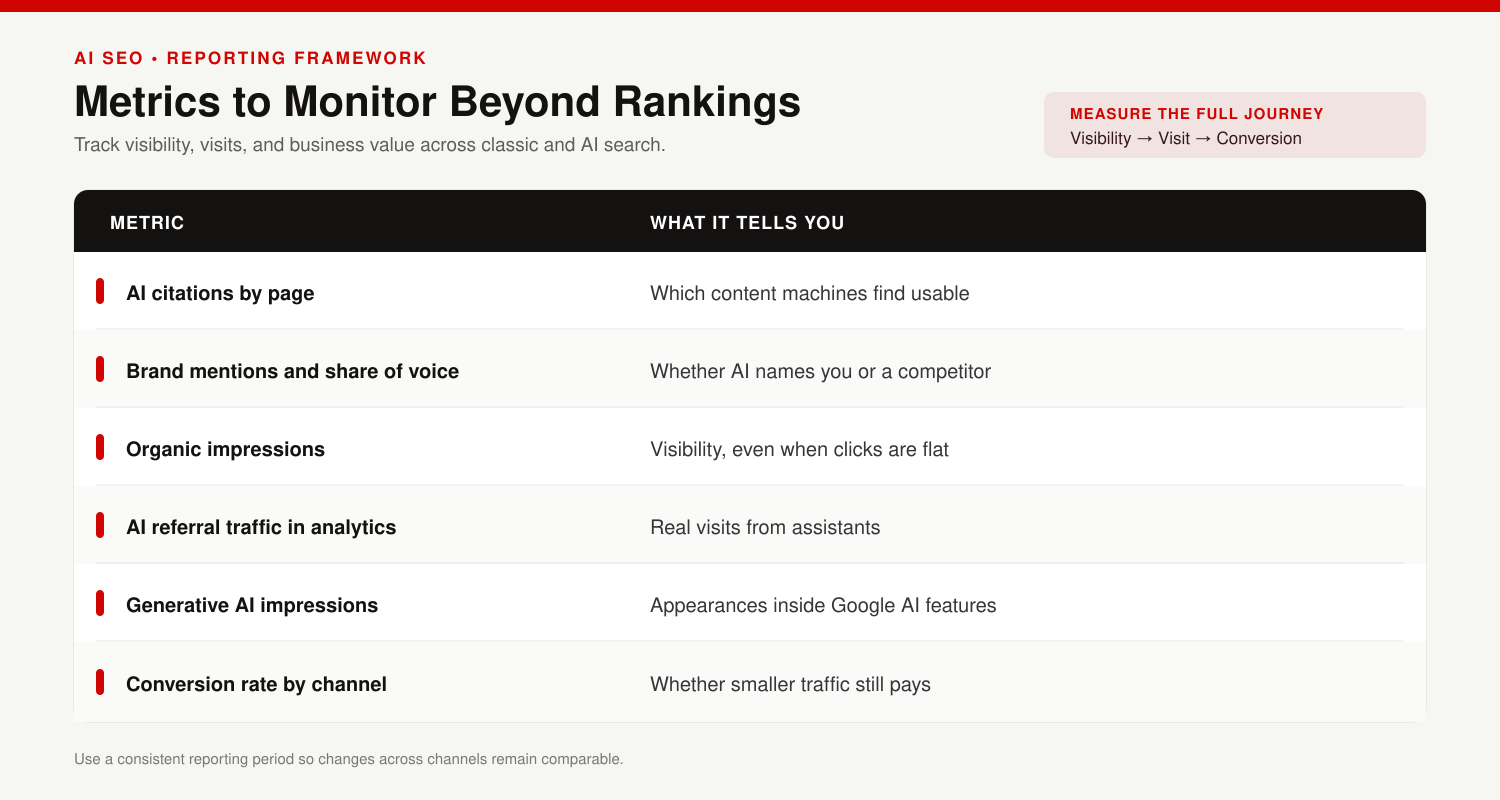
Google Search Console now includes a generative AI performance report showing impressions from AI Overviews and AI Mode by page, country, and device. It has no click or query data yet, and access is still rolling out, but it is free.
The honest read of these AI SEO statistics is that AI changed the payoff of SEO, not its fundamentals. Clicks per ranking dropped. Brand visibility and content quality became worth more. Businesses that publish useful content, run a fast site, and earn outside trust are still winning, and now they win on more surfaces at once.
If you want to know how your site is performing across both classic and AI search, book a meeting with our team or get in touch for a visibility review.
How is AI changing SEO in the United States?
AI answers now sit above or beside classic results for a large share of queries. Rankings still matter, but fewer people click, and being named inside an answer has become its own goal.
What percentage of Google searches are now zero-click?
Research from SparkToro and Datos put it around 58.5% of US searches before AI Overviews scaled. Pew found roughly two thirds of searches end without a click to another site.
How do AI Overviews affect organic rankings?
They do not change rankings directly. Google uses the same index. What changes is click-through, with studies showing the top result losing between roughly a third and half its clicks.
Does AI search reduce website traffic?
Often yes for informational pages. Pew measured clicks falling from 15% to 8% when a summary appeared. Transactional and branded queries are affected far less.
Is SEO still effective in the age of AI?
Yes. AI answers are drawn from the same index that ranks pages, so strong organic performance is still the main path into them. The return now shows up as visibility as well as clicks.
What metrics should businesses track beyond keyword rankings?
AI citations, brand mentions, share of voice, organic impressions, AI referral traffic, and conversion rate by channel. Impressions matter more when clicks fall for reasons outside your control.
Do AI Overviews appear for every type of query?
No. Informational and question-style searches trigger them far more often than transactional or ecommerce queries. Longer, natural-language questions are the most likely to produce one.
How do AI citations influence brand visibility?
Being cited puts your name in front of someone at the research stage, even without a click. Pew found only 1% of users click those links, so treat citations as brand impressions.
Why do AI SEO statistics vary so much between studies?
Each tracker uses different keyword samples, countries, devices, and detection methods. AI answers also change between users and sessions. Every figure is a sample, not a fixed fact.
Should businesses combine SEO and Google Ads in an AI-driven strategy?
Combining them helps. Ad data shows which terms bring buyers, which guides content. Better content raises ad quality scores and lowers cost per click, so each channel makes the other cheaper.


.png)

.png)
.png)

.png)
.png)
.png)






.svg)