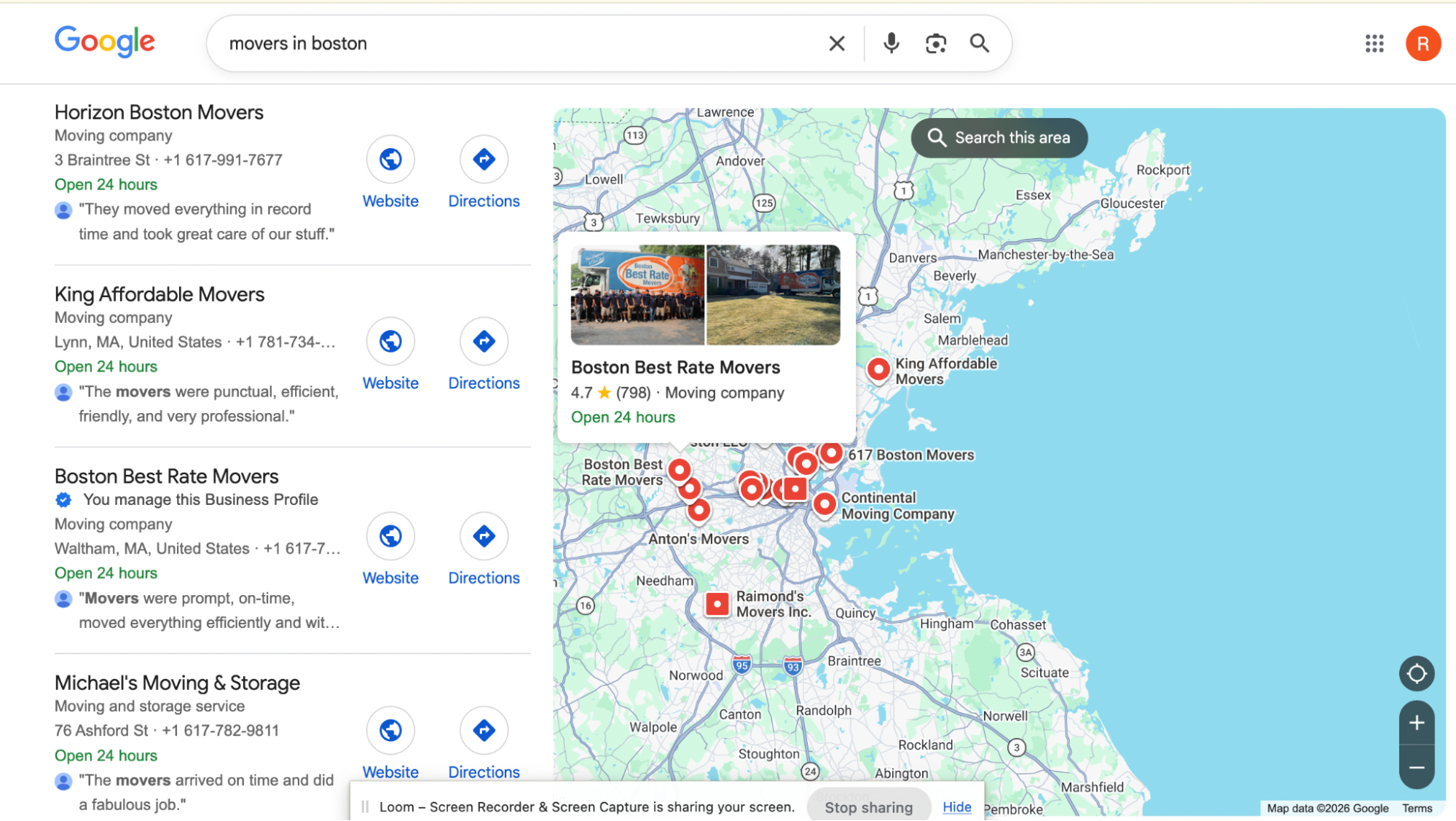
When someone nearby searches for what your business offers, Google Maps is often the first thing they see. The businesses that appear in that map pack get the majority of clicks, calls, and foot traffic. Everything below it competes for what is left.
Learning how to rank higher on Google Maps is one of the highest-return investments a local business can make, and our digital marketing team has found that most of the factors that influence it are well within your control.
Local search results have fundamentally changed how customers find businesses. A significant portion of local searches end with a visit, a call, or a purchase, and the map pack sits directly at the top of those results.
Businesses that rank higher on Google Maps capture that intent at its peak, reaching customers who are actively ready to act rather than passively browsing.
The map pack typically shows three businesses. Everyone outside those three positions faces a dramatic drop in visibility.
Local pack ranking is not just about being found. It is about being found before your competitors, and in local search that distinction often determines who gets the business.
Google determines local search ranking based on three core signals, and understanding each one is the foundation of any effective Google Maps optimization strategy.
Relevance
Relevance measures how well your Google Business Profile matches what someone is searching for. A profile that clearly describes your services, uses accurate categories, and includes the keywords your customers use will rank more relevantly than one that is vague or incomplete.
Distance
Distance measures how close your business is to the searcher or the location specified in the query. Proximity ranking means businesses physically closer to the searcher have a natural advantage for purely location-based searches. While you cannot move your business, you can optimize everything else to compensate when proximity is not on your side.
Prominence
Prominence measures how well known and trusted your business is based on information Google finds across the web. This includes your review signals, the quality and quantity of local citations, how often your business appears in reputable online sources, and the overall strength of your local search visibility.
AI tools like ChatGPT, Google Gemini, and Perplexity are changing how people search for local businesses, and that shift is creating new opportunities for businesses that are paying attention.
Google's AI overviews now appear at the top of many search results as AI-generated search summaries, pulling information directly from Business Profiles, review platforms, and authoritative local sources to answer search queries instantly.
Large language models (LLMs) built on natural language processing power these results by analyzing content for relevance, credibility, and semantic context rather than simply matching keywords.
Businesses with complete, well-optimized profiles that use natural language and structured data are the ones most likely to be featured in those generative search results.
As zero-click searches continue to rise, optimizing for AI overviews is becoming as important as traditional on-page SEO.
.png)
For local search specifically, content relevance, information accuracy, and E-E-A-T signals carry more weight than ever before. AI-powered search algorithms built on foundation models and deep learning are designed to surface businesses that clearly communicate what they do, who they serve, and where they operate.
A Google Business Profile that is detailed, accurate, and regularly updated gives AI search engines exactly the structured information they need to recommend your business with confidence.
Conversational search queries and voice search are accelerating this shift, rewarding businesses that write for people first and search engines second.
Conversational AI tools like Perplexity, ChatGPT, and Google Gemini are increasingly becoming the first stop for local business research.
When someone uses an AI chatbot or AI research assistant to find the best HVAC company nearby or a trusted accountant in their city, those tools pull from the same ranking signals Google uses, including review ratings, local citations, domain authority, and Business Profile completeness.
Answer engine optimization is becoming a natural extension of local SEO strategy as AI-powered search continues to grow.
Businesses that invest in strong local SEO fundamentals today, including keyword-optimized profiles, consistent NAP data, and authoritative backlinks, are positioning themselves not just for traditional Google Maps rankings but for AI-driven search results powered by generative AI and multimodal AI systems that are rapidly becoming the dominant entry point for local buying decisions.
The businesses that adapt early will have a measurable competitive advantage in local pack visibility.
No factor influences your ability to rank higher on Google Maps more directly than your Google Business Profile.
An incomplete, inconsistent, or neglected profile is the single most common reason local businesses fail to appear in the map pack despite operating in markets with genuine demand for their services.
A fully optimized profile covers every available field. Your business name, address, phone number, website, hours, and service areas need to be accurate and consistent with what appears everywhere else your business is listed online.
.png)
NAP consistency, the alignment of your name, address, and phone number across all platforms, is a foundational trust signal that Google weighs when determining local search ranking.
Beyond the basics, your profile should include a detailed business description written around your primary local keyword optimization targets, a complete and accurate category selection, regularly updated photos, and active use of the posts and Q&A features.
Each of these signals tells Google that your profile is current, managed, and worth surfacing to local searchers.
Review signals are among the most powerful factors in local pack ranking. The volume of your reviews, their average rating, how recently they were posted, and how consistently you respond to them all contribute to how Google assesses your business's prominence and trustworthiness.
Businesses that rank higher on Google Maps consistently have more reviews, more recent reviews, and higher response rates than those below them.
This is not coincidental. Google interprets active review engagement as a sign that the business is legitimate, responsive, and worth recommending to searchers.
Getting more reviews requires making the process easy for customers. A direct link to your Google Maps listing for review submission, included in follow-up emails or on printed materials, removes the friction that prevents satisfied customers from sharing their experience.
The businesses that generate reviews consistently do so because they have built the ask into their process rather than hoping customers will do it on their own.
Local citations are mentions of your business name, address, and phone number on external websites, directories, and platforms. They function as trust signals that reinforce the legitimacy of your Google Maps listing.
The more consistent and widespread your citations are, the stronger the signal Google receives that your business information is accurate and reliable.
Inconsistencies in your citations create conflicting signals that can suppress your local search ranking. A business listed as "Main Street" in one directory and "Main St." in another may seem trivial, but at scale those inconsistencies introduce doubt about which information is correct.
Auditing your citations across major directories and correcting inconsistencies is one of the more straightforward ways to strengthen your local SEO foundation without creating new content.
According to, Local Citations and Why Consistency Across the Web Matters citation consistency and Google Business Profile signals consistently rank among the top factors influencing local pack performance across industries and markets.
Your website supports your Google Maps ranking in ways that are easy to overlook. Google does not evaluate your Google Maps listing in isolation. It cross-references your profile against your website to verify consistency and assess the overall authority of your local presence.
Local keyword optimization on your website, particularly on your homepage and any location-specific service pages, reinforces the relevance signals in your profile. Including your full business name, address, and phone number in your website footer, and embedding a Google Maps listing directly on your contact page, strengthens the connection between your site and your local search identity.
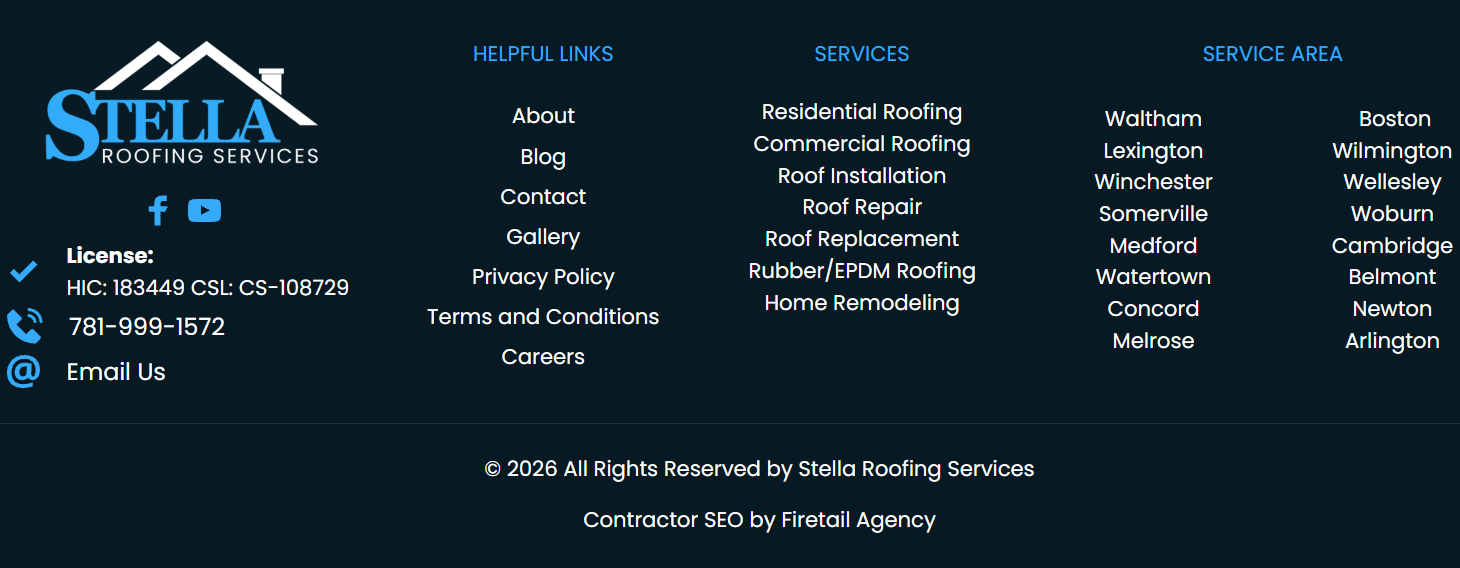
For businesses serving multiple areas, dedicated location pages built around city-specific terms give Google additional signals about the markets you serve and how you serve them.
Each page needs genuinely distinct content rather than templated copy with a city name swapped in, which On-Page Local SEO and Its Role in Maps Performance identifies as one of the key differentiators between location pages that rank and those that do not.
Ranking higher on Google Maps is not a one-time task. It requires consistent attention to your Google Business Profile, steady review generation, citation maintenance, and on-page local SEO that stays aligned with how your business and market evolve over time.
The businesses that dominate their local map pack rankings do so because they treat Google Maps optimization as an ongoing priority rather than a setup task. Small, consistent improvements compound into a local search visibility advantage that is increasingly difficult for competitors to close.
If building and maintaining that system while running your business is more than your team can take on, ReachGiant's local SEO services are built to handle exactly that. Book a meeting with ReachGiant to talk through what a stronger Google Maps presence could mean for your business.
1. What is the Google Maps map pack and why does it matter? The map pack shows the top three local business listings at the top of Google search results. It sits above organic results and captures searchers who are ready to act, making it the highest-visibility position in local search.
2. How long does it take to rank higher on Google Maps? Most businesses see meaningful improvements within two to three months of consistent effort. Profile completeness, review volume, and citation consistency are the core factors that respond to improvement most quickly.
3. Does my website affect my Google Maps ranking? Yes. Google cross-references your profile against your website for consistency. Strong local keyword optimization, consistent NAP information, and location-specific content all reinforce your Maps ranking.
4. How many reviews do I need to rank higher on Google Maps? There is no fixed number. Review quantity, recency, rating, and response consistency all factor in. Fewer recent reviews with a high response rate will often outperform more reviews that are older and unanswered.
5. What is NAP consistency and why does it affect local rankings? NAP is your name, address, and phone number. These must appear identically across all platforms. Inconsistencies create conflicting signals that can suppress your local pack ranking.
6. Can I rank on Google Maps for areas outside my physical location? Yes, to a degree. Service area businesses can specify regions in their profile without a physical address. Location-specific pages and local citations for each area also help extend your visibility.
7. How often should I update my Google Business Profile? Regularly. Updating photos, posting updates, responding to reviews, and keeping hours accurate all signal to Google that your profile is active and managed.
8. Do Google Maps rankings differ from regular Google search rankings? Yes. Maps rankings rely on relevance, distance, and prominence. Organic rankings depend more on domain authority and content quality. A strong local SEO presence improves performance in both.
9. What is the fastest way to improve my Google Maps ranking? Complete your Google Business Profile, fix citation inconsistencies, and generate recent reviews. These are the foundational elements Google weighs most heavily and are entirely within your control.
10. When should I hire an agency to help with Google Maps ranking? When profile management, review generation, and citation auditing exceed your team's capacity, or when your ranking has stalled despite your own efforts. A dedicated local SEO team brings the tools and consistency most businesses cannot maintain independently.


.png)

.png)
.png)

.png)
.png)
.png)






.svg)