
Ranking in one city is hard enough. Ranking in five, ten, or twenty takes a fundamentally different approach to keyword research. Most businesses that expand their SEO to multiple markets make the same mistakes, targeting generic terms across all locations and duplicating content with a city name swapped in.
ReachGiant’s SEO team will guide you on keyword research for multiple locations from the start to finish. This will save time, budget, and structural mess later.
The instinct when expanding to new markets is to take what worked in one city and replicate it everywhere. The problem is that search behavior is not uniform across locations.
A term that drives strong local search visibility in one market may have minimal search volume in another, or face a completely different competitive landscape.
Applying a one-size-fits-all keyword strategy across locations means you are either over-investing in markets where opportunity is limited or under-investing in markets where demand is high.
Location-based keywords carry local search intent that varies by geography, demographics, and even seasonal patterns. A roofing company targeting "roof repair" in Miami is competing against a very different set of businesses and searchers than the same company targeting the same term in Minneapolis.
Treating those as equivalent is the first mistake multi-location keyword research is designed to prevent.

Step 1: List Potential Keywords Based On Your Business’ Goals
Start by listing the core products and services your business offers, then combine them with the locations where you operate. Think like a customer by asking what someone would type into Google to find a business like yours, whether that is "plumber in Austin" or "financial advisor in New York” or “custom van builders in Florida."
You now have a list of several seed keywords that will help you get started with your local keyword research.
Step 2: Expand Your List With Keyword Research Tools
There are several tools available that can help expand your initial list of keywords. Navigate to through SEO keyword research tools like Ahrefs, Google Keyword Planner, or Keyword Surfer to uncover related keyword variations.
Pay close attention to the "People Also Ask" and "Related Searches" sections, as these reveal exactly how real users phrase their local searches.
Top 5 SEO Keyword Research Tools:
Ahrefs is a comprehensive SEO tool that provides in-depth keyword research, backlink analysis, and competitive insights to help improve search rankings.
Google AutoSuggest is a feature within Google Search that predicts search queries in real time, helping users discover popular and related keyword ideas.
SEMrush is an all-in-one digital marketing platform that offers keyword research, competitor analysis, and SEO performance tracking.
Google Keyword Planner is a free keyword research tool by Google that helps advertisers and marketers find keyword ideas, search volumes, and cost-per-click estimates.
Keyword Surfer is a browser extension that displays keyword search volumes and related keyword suggestions directly within Google search results.
Step 3: Evaluate Search Volume and Keyword Difficulty
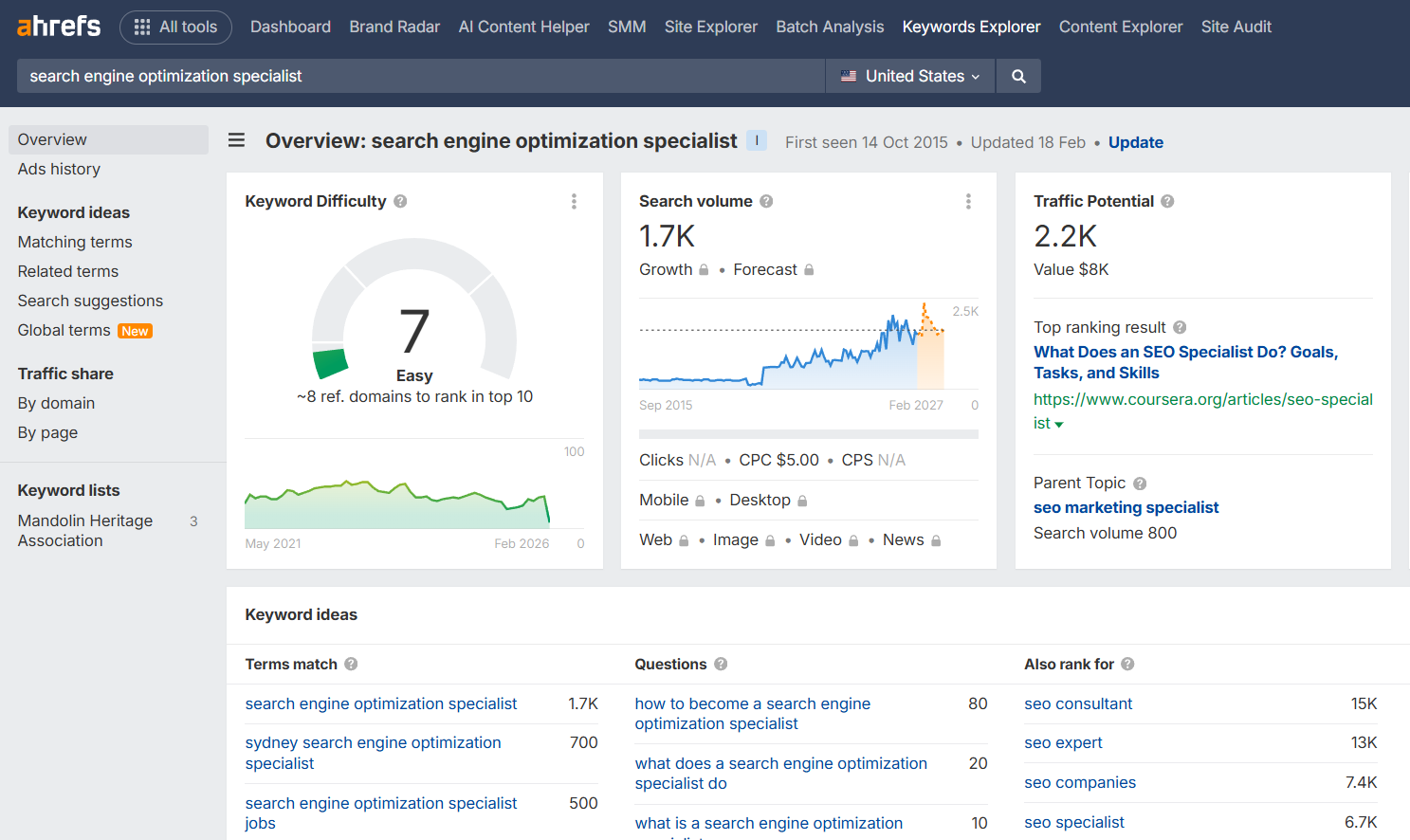
Not every keyword on your list is worth targeting. Prioritize keywords with a healthy search volume and low competition, since these give your business the best chance of ranking without going up against heavily established competitors.
Ahrefs’ Keyword Difficulty for example, gives an estimation of how hard it is to rank in the top 10 organic search results for a keyword on a 100-point scale.
Step 4: Analyze Your Competitors' Keywords
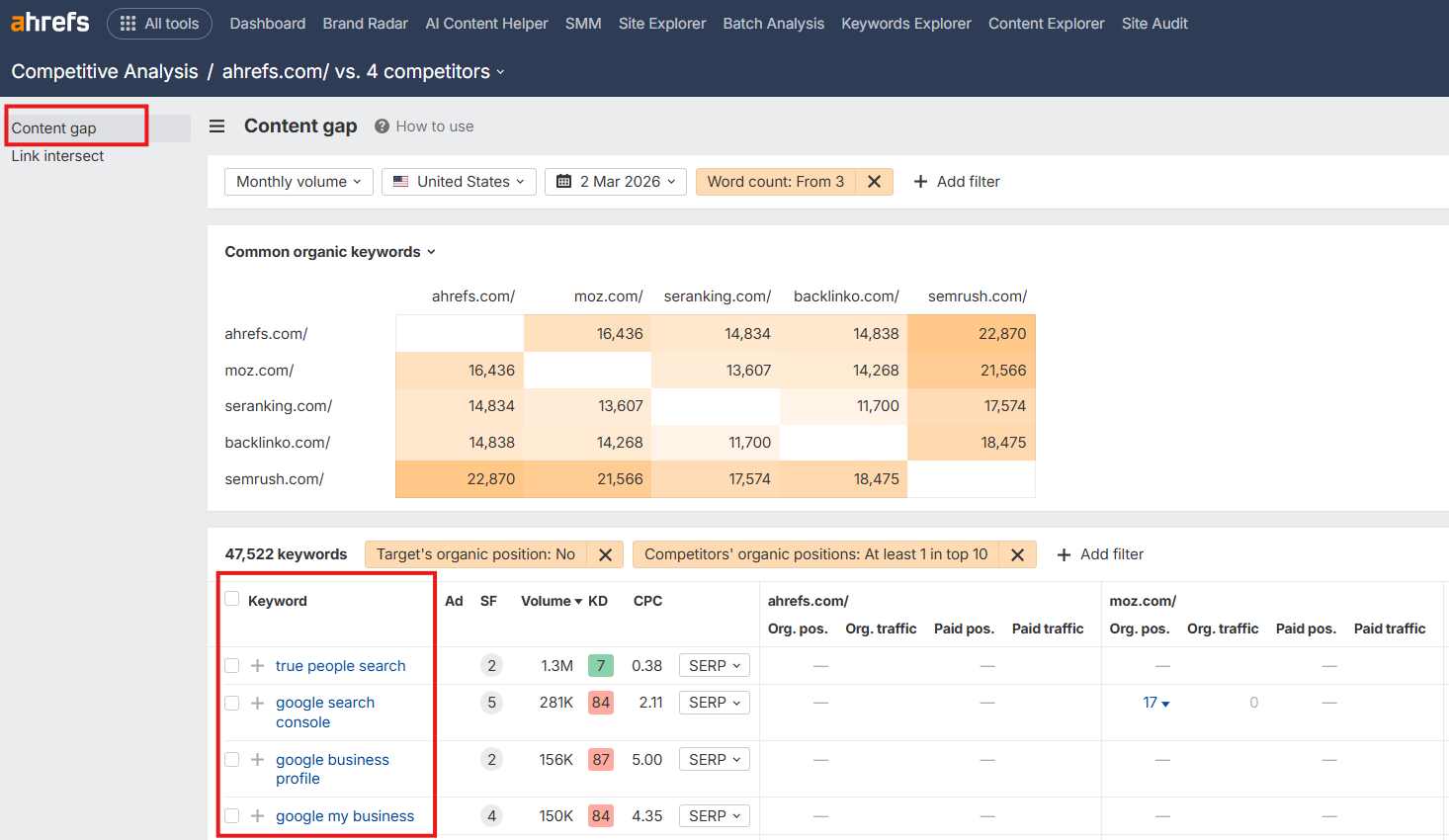
Look up the local keywords your top competitors are already ranking for to identify gaps in your own content. Targeting keywords where competitors have low authority gives you a realistic path to the first page of Google.
Step 5: Group Keywords Into Clusters and Map Them to Pages
Organize related keywords into topic clusters and assign each cluster to a specific page on your website. This prevents keyword cannibalization, strengthens your topical authority, and ensures every page has a clear, focused purpose in your overall SEO strategy.
Keyword research for multiple locations is only useful if it feeds into location pages built to rank. The most common mistake is creating near-identical pages for each city with only the location name changed.
Search engines, now powered by large language models (LLMs) and natural language processing, recognize thin, templated content and assign it little value. Each location page needs to reflect genuine local relevance, not just geographic keyword insertion.
Local SERP rankings increasingly favor pages structured to appear in generative search results and AI answer boxes. Reference local context and address location-specific needs. Build each page around the keyword clustering strategy your research produced for that market.
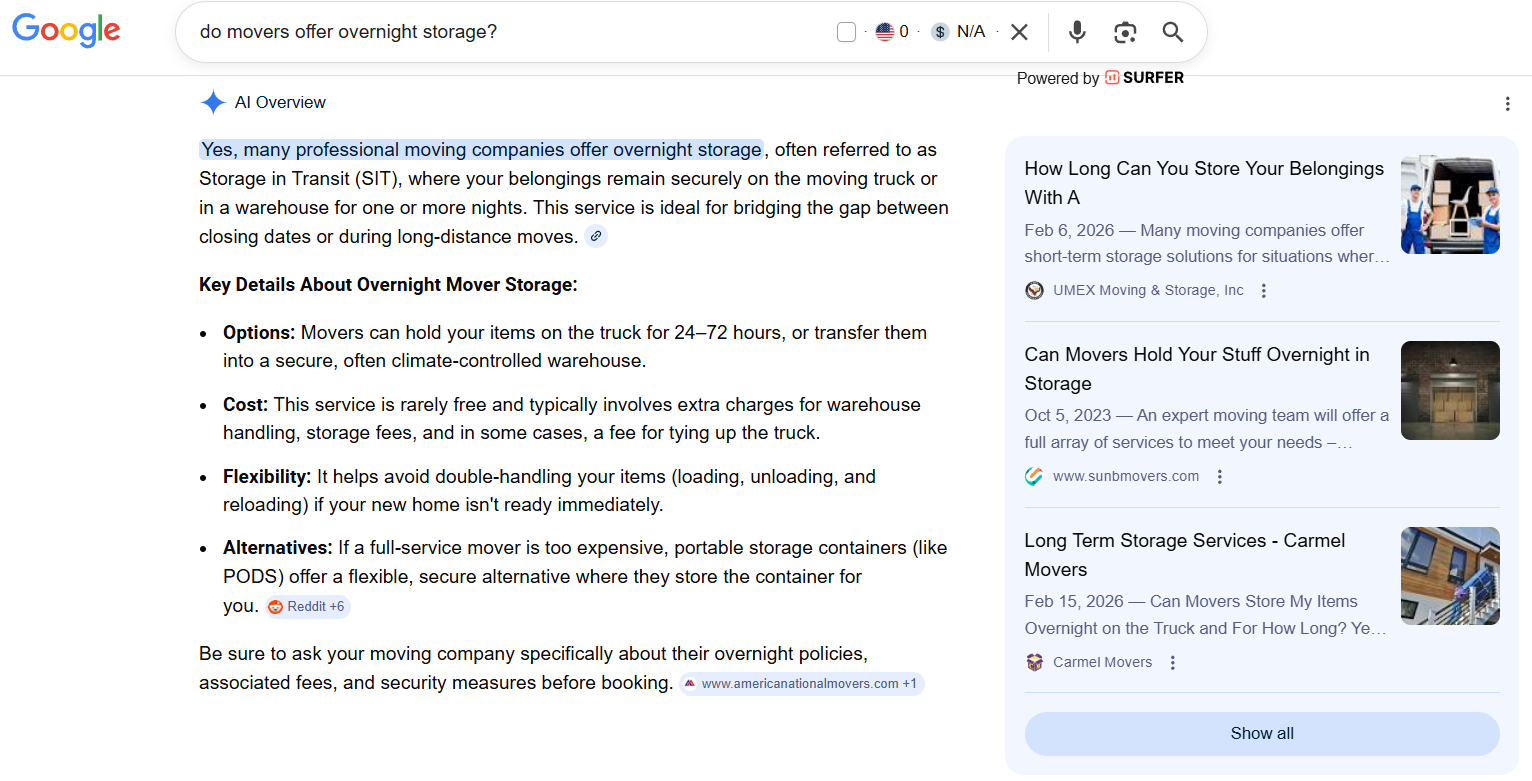
As conversational search continues to grow, pages written in natural, direct language are better positioned to surface as AI-generated answers and AI search summaries. Answer engine optimization is no longer separate from local SEO.
According to Moz's Local SEO Guide, location pages that incorporate locally relevant content and structured data consistently outperform generic pages across competitive local markets.
Keyword cannibalization is one of the biggest risks in multi-location SEO. When multiple location pages target the same or overlapping geo-targeted keywords without sufficient differentiation, they compete against each other rather than reinforcing your overall authority.
Search engines struggle to determine which page deserves priority, and the result is that none of them rank as well as they should.
Preventing cannibalization requires a clear keyword ownership structure where each location page has a defined set of primary and supporting terms that do not overlap significantly with other location pages.
Your keyword clustering work from the research phase is what makes this possible. If two location pages are targeting identical terms, one of them needs to be repositioned or the content needs to be differentiated enough to serve genuinely distinct search intents.
Search Engine Journal's guide to keyword cannibalization covers the diagnostic process in detail for businesses managing large numbers of location pages.
The value of doing keyword research for multiple locations properly is that it creates a repeatable system. Once you have a framework, adding a new market means running the same research process for that location and slotting it into your existing structure rather than starting from scratch.
That scalability is what separates businesses that grow their local search visibility efficiently from those that constantly rebuild their SEO foundation every time they enter a new market.
If managing keyword research across multiple locations while running a business feels like more than your team can take on, ReachGiant's SEO services are built around exactly this kind of multi-location strategy. Book a meeting with our team to talk through what a location-based keyword framework could look like for your business.
1. What is keyword research for multiple locations and why does it matter? It identifies the search terms customers use in each market you serve. Search behavior varies by location, so a strategy built for one city will not automatically produce results in another.
2. How is multi-location keyword research different from standard keyword research? Standard research targets a single market. Multi-location adds a geographic layer requiring separate analysis of volume, competition, and local intent per market, while managing keyword cannibalization risks between location pages.
3. How many keywords should I target per location? One primary keyword, two to three supporting keywords, and a set of LSI terms per location page. Depth matters more than volume.
4. What tools are best for keyword research across multiple locations? Google Keyword Planner for location-filtered volume, Search Console for actual traffic queries, and Ahrefs or Moz for location-level competitive analysis.
5. How do I avoid keyword cannibalization across location pages? Assign clear keyword ownership before building pages. Each page needs defined terms that do not overlap significantly with others. If two pages target identical terms, one needs repositioning.
6. Should every location page target different keywords? Core service keywords will repeat, but geographic modifiers and supporting terms should be market-specific. Researching each market individually captures meaningful differences in local intent.
7. How do I prioritize which locations to target first? Start with markets that show strong demand and limited competition. Existing customer data can also signal where organic interest already exists.
8. What makes a location page rank well in local search results? Genuine local relevance, location-specific content, and tightly clustered geo-targeted keywords. Page speed, mobile optimization, and structured data also contribute.
9. How does Google Business Profile fit into a multi-location keyword strategy? Your Profile influences map pack rankings while location pages drive organic results. Keeping both optimized with consistent, location-specific content improves visibility across both surfaces.
10. When should I hire an agency to manage multi-location keyword research? When the volume of locations or complexity exceeds your team's capacity, or when location pages are underperforming and structural mistakes need to be avoided.




.png)

.png)
.png)

.png)
.png)
.png)






.svg)